Every spell, on one shelf
325 spells and 973 versions, each with its history, timing and sources. Filter by purpose, moon or land, or show only what suits tonight's moon.
Protection
Wards, amulets and charms that keep harm away from people, homes and roads.
The Acorn Charm
A dried acorn, or an acorn-shaped pull on a window blind, kept to guard a house from lightning and to bring steady luck and long life. It draws on the old tie between the oak and the thunder god.
The Hag Stone
A pebble with a natural hole worn through it, hung by a cord over a bed, a door or a stable to keep away nightmares, witches and bad luck.
The Hamsa Hand
An open right hand, often with an eye in the palm, hung in the home or worn to push back the evil eye and bless a household.
The Ankh Amulet
The ancient Egyptian hieroglyph for life, a cross with a loop at the top, carried by gods in art and worn by the living and buried with the dead as an amulet for health, safety and rebirth.
Black Cat Superstition
In the United States a black cat crossing your path is usually called bad luck, but in Britain, Ireland, Scotland and Japan black cats are often lucky. The bad reputation grew from Europe's witch-hunt era, when cats were cast as familiars; the claim that Pope Gregory IX ordered black cats killed is a myth.
Black Salt for Protection
A modern protective mix of ordinary salt darkened with ash, charcoal or black pepper, sprinkled across doorways and windowsills to keep unwanted influences out. It is not the same thing as kala namak, the edible Indian black salt.
The Bottle Tree
A tree or post hung with glass bottles, traditionally cobalt blue, set in a yard in the American South so that wandering or harmful spirits are drawn into the bottles, trapped, and burned away by morning sun.
Broken Mirror Superstition
Breaking a mirror is said to bring seven years of bad luck. Folk remedies include burying the pieces, washing them in running water, grinding them to powder, or keeping your reflection out of the broken glass, all done while staying safe from sharp shards.
The Cimaruta, Italian Rue Charm
A silver charm from Naples shaped like a branching sprig of rue, with tiny symbols such as a key, a crescent moon, a heart and a hand hanging from its tips. It was traditionally hung over a baby's bed or worn to ward off the evil eye.
The Dzi Bead
An ancient etched agate bead, dark with white lines and circular eyes, treasured in Tibet and the Himalayas as a protective amulet. Old dzi are rare and costly and belong to a living Buddhist and Himalayan culture; an honestly labeled etched agate bead is an open way to wear the idea.
Fern Seed for Invisibility
The old belief that 'seed' gathered from a fern at midnight on Midsummer Eve would make its carrier invisible. Ferns have no seeds, only spores, and the modern version treats invisibility as going unnoticed and unbothered.
Fiery Wall of Protection
A hoodoo protection formula and candle spell that pictures a ring of fire around a person or home, meant as a shield that keeps harm out without sending any back.
Four Thieves Vinegar
An herbal vinegar tied to a legend of plague-time thieves who robbed the sick without catching the disease, now kept as a household protection and cleansing vinegar for doorways, hands and surfaces.
The Fu Talisman and the Door Charm
Written charms on red or yellow paper, or on peach wood, pasted at the door or carried, to keep harmful spirits out of a home in Chinese tradition.
Garlic Protection Charm
Hanging or carrying garlic to keep harm away, one of the most widespread protective customs in the world, from Homer's magic herb moly to the Balkan vampire lore that gave us Dracula's garlic.
The Jack-o'-Lantern
A hollowed vegetable, now usually a pumpkin, carved with a face and lit from within at Halloween. In Ireland and Britain the turnip or mangelwurzel lanterns were set in windows to keep harmful spirits away, and the Irish tale of Stingy Jack explains its name.
Karma Spell: Letting It Return
A release ritual for when someone has wronged you: instead of cursing them, you hand the matter back to whatever justice you believe in and cut your own tie to the anger. The page also explains what karma means in Hindu and Buddhist thought and how it differs from the Wiccan threefold law.
Knock on Wood
Knocking on wood, or touching wood in Britain, is a quick ritual done after praising your own luck or mentioning something you hope will continue, to keep from 'tempting fate'. Its origin is disputed: tree spirits and the Christian cross are popular theories, but folklorists find the custom recorded only from the 1800s.
Krampusnacht
The night of 5 December in the Alpine countries, when Saint Nicholas brings gifts to good children and his horned companion Krampus threatens the naughty with birch switches. Masked Krampus and Perchten runs are also said to chase off the dark spirits of winter.
The Mjölnir Pendant (Thor's Hammer)
A small pendant shaped like the hammer of the Norse god Thor, worn for protection and strength. Hundreds of real hammer amulets survive from Viking Age Scandinavia, most from the 10th century, and the symbol is worn today by followers of modern Heathenry and anyone drawn to Norse heritage.
The Nazar: Turning Back the Evil Eye
A blue glass eye bead hung in the home or worn on the body so that envious or admiring looks are caught and reflected before they can do harm.
Ojo de Dios, the God's Eye
A diamond of colored yarn woven around two crossed sticks. Among the Wixárika (Huichol) people of western Mexico, the sikuli is a sacred object made for a child's protection; the yarn God's eye made in craft classes is a separate, open folk craft that can carry your own blessing.
Omamori, Japanese Protective Amulets
Small brocade pouches sold at Shinto shrines and Buddhist temples in Japan, each holding a blessed paper or wood slip for a specific kind of protection or luck. You carry one unopened for about a year, then return it to be burned with thanks.
The Pentagram and the Pentacle
The pentagram is a five-pointed star drawn in one unbroken line; a pentacle is that star set inside a circle, or, in ritual magic and Wicca, a disc engraved with it. Used for thousands of years for health, protection and the five elements, it only gained its sinister reputation in the 19th century.
The Protection Jar
A sealed jar of salt, iron nails, rosemary and other protective herbs kept by the door or buried near the house, the most popular modern protection spell and a direct descendant of the English witch bottle.
Red Brick Dust Threshold Line
Powdered red brick laid across a doorstep or around a property, a hoodoo protection meant to stop anyone with bad intentions, or any trick laid down for you, from crossing into the home.
The Red Coral Horn (Cornicello)
A small twisted red horn, traditionally carved from Mediterranean coral, worn in southern Italy against the malocchio, the evil eye, and for luck and fertility. Coral itself has been an amulet for children since Roman times.
Return to Sender Mirror Spell
A reflective protection spell that uses a mirror, turned outward, to bounce any ill will or bad luck back toward wherever it came from. It names no one: the mirror simply refuses to hold what is sent.
The Reversal Candle (Double Action Candle)
A hoodoo candle spell that uses a candle half black and half another color, turned upside down and burned on a mirror, to burn away bad luck and send it back where it came from.
The Triquetra
A knot of three interlaced arcs, common in early medieval Irish and Anglo-Saxon art such as the Book of Kells, later read as a symbol of the Christian Trinity and today worn as a Celtic and Pagan sign of threefold protection and unity.
The Troll Cross
A ring of iron bent so its ends cross and curl, sold as an ancient Scandinavian charm against trolls and evil magic. The jewelry form is a modern invention by a Swedish smith in the late 1990s, though iron charms and protective house marks in Sweden are genuinely old.
The Rowan Cross and Red Thread
Two rowan twigs bound into an equal-armed cross with red thread and placed over doors, byres and cradles to keep witches and fairies out.
Throwing Salt Over Your Shoulder
Spilling salt is an old omen of bad luck or a quarrel. The customary remedy is to take a pinch of the spilled salt with your right hand and throw it over your left shoulder, where the Devil is said to wait, to blind him.
The Salt Circle
A ring of salt poured on the floor around a person or a working space to mark a protected area that harmful influences cannot cross, drawing on the much older magic circle of ritual magic.
The SATOR Square
A five-by-five Latin word square that reads the same in every direction, written on walls, plates and paper for nearly two thousand years against fire, illness and bewitchment.
The Scarab Amulet
An ancient Egyptian amulet carved as a dung beetle, the creature of the sunrise god Khepri, worn for renewal and good fortune and, as the large heart scarab, laid on mummies to keep the heart from speaking against its owner at judgment.
The Seal of Solomon
The legendary signet ring of King Solomon, said to give him command over demons, and the star symbol (a hexagram or a pentagram) later used for it on amulets across Jewish, Christian and Islamic magic.
Sneezing Superstition and 'Bless You'
Saying 'bless you' after a sneeze is one of the oldest living customs in the world. Greeks and Romans already treated sneezes as omens and wished sneezers well; the popular story that Pope Gregory I began it during the plague of 590 is a later tradition without solid evidence.
Stop Gossip Protection Spell
A protective working for when people are talking about you: a small slippery elm and salt sachet, a snake plant by the door, and a psalm against lying lips. It shields you and your reputation; it does not gag, bind or harm anyone.
Walpurgis Night
The night of 30 April, when German folklore said witches gathered on the Brocken mountain, and people lit hilltop fires, rang bells and made noise to drive them and winter away. It is still kept with bonfires in Sweden, Finland, Germany and the Czech Republic.
War Water (and a Safe Iron Water for Your Own Door)
War water is a rusty-iron water from hoodoo tradition, historically thrown in a bottle at an enemy's doorstep to start strife. This page covers that history only and gives a safe, purely protective iron water for guarding your own threshold.
The Witch Ball
A hollow glass sphere, often colored or silvered and sometimes filled with glass threads, hung in a window to catch, dazzle or trap evil spirits and ill wishes before they enter the house.
The Witch Bottle
A sealed bottle of pins, nails and personal traces hidden in a house to trap or turn back harmful magic aimed at the people living there.
Witch Marks and the Daisy Wheel
Compass-drawn flowers, interlaced lines and Marian VV marks scratched near doors, windows and hearths to block evil from entering a building.
The Witch's Knot
An endless interlaced knot of four loops, drawn, carved or tied as a protective sign over doors and worn as a pendant. The design is popular in modern witchcraft, but its specific witch's-knot lore is recent; the older relative is the Nordic looped square called Saint John's arms.
Hex Signs and Barn Stars
Round, brightly painted star and rosette designs on the barns of southeastern Pennsylvania. Whether they were ever meant as magic is a real scholarly debate: the name hex sign only appeared in the 1920s, and many historians see the old barn stars as decoration and pride.
The Eye of Horus (Wedjat)
An ancient Egyptian symbol of the falcon god Horus's eye, torn out by Seth and restored by Thoth, worn as one of Egypt's most popular amulets for healing, wholeness and protection by the living and the dead.
Ægishjálmur, the Helm of Awe
An Icelandic magical stave of eight trident-tipped arms around a central point, drawn to make the bearer fearsome to enemies and shielded from harm.
Tech & Machines
Blessings and wards for computers, phones, servers and code, built on documented rites for tools, ships and workshops.
Abracadabra Bug-Shrinking Charm
Abracadabra began as a Roman fever cure: the word written in a triangle that lost a letter on each line, so the illness would shrink away with it. This page tells that history and adapts the shrinking triangle as a way to narrow down a stubborn bug.
The Alu Inscription for a Program or Server
Alu and laukaz are mysterious formula words carved in Elder Futhark runes on amulets, gold bracteates and stones between about the 3rd and 8th centuries. This page explains what runologists know of them and how to inscribe alu, alone or as a bindrune, in a program's comments or on a server as a protective mark.
Ayudha Puja for Computers and Tools
Ayudha Puja is the Hindu day, falling at the end of Navaratri, when people clean, decorate and honor the tools of their work, from ploughs and lathes to cars, laptops and phones. This page explains the real festival and gives a simple, respectful way to thank and rest your own working machines.
Blessing for Any Thing: a Computer Blessing from the Roman Ritual
The old Roman Ritual includes a short blessing for any object that has no special form of its own, and its later editions added blessings for telegraphs, aeroplanes and machinery. This page explains that history and gives a simple lay prayer of blessing for a new computer, phone or tool.
Blessing the Daemons: Background Processes
In computing, a daemon is a program that runs quietly in the background doing chores. The name came from Project MAC at MIT around 1963, inspired by Maxwell's demon in physics and, behind that, the Greek daimon, a guiding spirit. This page explains the real history and gives a short blessing for the daemons on your own machines.
Bone to Bone: a Merseburg Repair Charm for Hardware
The Second Merseburg Charm, a ninth or tenth century Old High German healing spell, closes with a famous list: bone to bone, blood to blood, limb to limb, as if they were glued. This page tells its history and adapts that joining formula as a charm said while repairing broken hardware.
Daisy Wheel Ward for a Login Page or Firewall
The daisy wheel, a six-petalled flower drawn with a compass, is the most common of the ritual protection marks carved at doors, windows and fireplaces of old English buildings. This page explains that history and adapts the mark as a ward for the digital threshold: a login page, a router or a firewall.
The First Bug: a Logbook Rite for Debugging
On 9 September 1947, operators of the Harvard Mark II computer found a moth trapped in a relay and taped it into the logbook as the first actual case of a bug being found. Grace Hopper made the story famous. This page tells what really happened and offers a small debugging rite of logging and thanks. It is history, not magic.
The Gremlin Ward
Gremlins were the mischievous little beings British airmen blamed for unexplained faults in their aircraft from the 1920s through the Second World War. This page tells the real history of that folklore and gives a light-hearted, practical ward against gremlins for any machine.
IT Omamori and the Kuyo Farewell for Devices
Kanda Myojin, the old Tokyo shrine beside Akihabara, sells an omamori for the safety of computers and data. Japanese Buddhism also holds kuyo, memorial rites of thanks for worn-out tools, from sewing needles to Sony's Aibo robot dogs. Together they give a full life cycle for a machine: a charm when it arrives and a thank-you when it goes.
Launch Christening for Software
Ships have been named and blessed at launch for thousands of years, from Mesopotamian offerings to the broken bottle on the bow. This page tells that history and adapts it as a short naming and blessing for launching software, an app or a website.
Helm of Awe Stave for a Device
The Helm of Awe is an Icelandic magical stave of eight armed tines, recorded in early modern manuscripts as a sign of protection and of overawing opponents. It is not a Viking symbol. This page explains where it really comes from and how to draw it as a protective mark on a laptop, phone case or server rack.
Saint Isidore of Seville, Proposed Patron of the Internet
Isidore of Seville, the seventh-century bishop who wrote an encyclopedia of everything known in his day, is the saint most often proposed as patron of the internet. He has never been officially named to that role. This page sets out the real history and a short prayer before going online.
The Sator Square in Code
The Sator square is a five-by-five Latin word square that reads the same in four directions, found at Pompeii and used as a protective charm across Europe for centuries. This page explains its history and shows how to inscribe it in a code comment or on a device as a quiet ward.
Home & Hearth
Threshold customs, house blessings and the quiet magic of keeping a household.
Bread and Salt for a New Home
A loaf and a little salt carried into a new home or offered at its door, so the household will never go hungry and life there will keep its savour.
Brigid's Bed and the Brat Bríde
On the eve of 1 February, Irish and Scottish households invited Brigid into the house: they made her a bed, set out a doll of rushes or oats, smoothed the ashes to look for her mark, and left a cloth outside for her to bless as a healing charm.
Brigid's Cross
A cross woven from fresh rushes on St Brigid's Eve and hung in the house and byre to guard against fire, hunger and harm for the year ahead.
The Brownie House Spirit
A brownie is a small, shaggy household spirit of Scottish and northern English folklore who does chores at night in return for a bowl of cream or milk and a bit of bread. Insult him, show off his work, or hand him a gift of clothes, and he leaves for good.
Chalking the Door
An Epiphany custom in which Christians write the year, crosses and the letters C, M and B in chalk above the front door. The letters stand for the Magi Caspar, Melchior and Balthazar and for the Latin blessing Christus mansionem benedicat, May Christ bless this house.
The Concealed Shoe
A worn shoe hidden in a chimney, wall or roof during building work, to guard the household and carry the luck and shape of its owner into the house.
The Dala Horse for Home Luck
A hand-carved, brightly painted wooden horse from the Dalarna region of Sweden, now a national symbol of home, hospitality and good fortune. Placing one by the hearth or door is a simple luck charm for the household.
The Domovoi
The domovoi is the guardian spirit of the Slavic household, usually pictured as a small, hairy old man who lives behind the stove. Kept happy with bread, salt and leftovers, he protects the family and livestock, and when the family moves house he must be invited to come along.
Fairy Offerings and Fairy Ring Lore
Fairy rings are natural circles of mushrooms that European folklore blamed on dancing fairies or witches, and stepping inside one was said to be dangerous. Across Britain and Ireland, households left milk, bread or butter for the fairies to keep on good terms with them.
First-Footing at Hogmanay
The first visitor to cross the threshold after midnight on New Year sets the household's luck for the year, so they arrive with gifts of coal, bread, salt and drink.
The Mezuzah
A small handwritten parchment scroll of verses from Deuteronomy, rolled into a case and fixed to the doorposts of a Jewish home, fulfilling the commandment to write God's words on the doorposts of your house. It is a living mitzvah, not a decoration or a lucky charm.
Moving House Blessing
A pair of rituals for leaving one home and entering the next: a thank-you sweep for the house you are selling, and a first-entry blessing with bread, salt, rice and a new broom for the new one. It draws on moving customs from Eastern Europe, China, Japan and Appalachia.
The Nowruz Haft-sin Table
The table of seven symbolic items whose Persian names begin with S, set for the Persian new year at the spring equinox, with the fire-jumping of Chaharshanbe Suri before it and the release of the sprouts into running water on the thirteenth day after.
The Tomte (Nisse)
The tomte, or nisse, is the small, grey-clad, red-capped farm spirit of Scandinavian folklore who looks after the house and animals. He expects respect all year and a bowl of Christmas porridge with a pat of butter on top, and grew into the Christmas gnome familiar today.
The Horseshoe Over the Door
A used iron horseshoe nailed above a doorway to bring luck into the house and keep the Devil, witches and fairies out.
Pet Protection Blessing
A home blessing for a dog, cat or other animal, modelled on the church blessings of animals held on St Francis's feast, October 4. It asks for health and safe return, and it comes with the practical checks that actually keep pets safe.
Pomander and Clove Orange
A pomander was a ball of scented paste, often carried in a pierced gold or silver case, that wealthy Europeans held to their noses to ward off disease and bad smells. Today the name usually means an orange studded with cloves and dried for Christmas, a home charm for warmth, welcome and abundance.
Saint Lucy's Day
The feast of Saint Lucy on 13 December, once the longest night of the year under the old calendar. In Sweden and the rest of Scandinavia the eldest daughter, dressed in white with a crown of candles, wakes the household with coffee and saffron buns to carry light into the darkest time.
Sweetening the Kitchen God's Lips
Before Chinese New Year, families send the Kitchen God back to Heaven to report on the household, first smearing honey or malt candy on his lips so his report will be sweet, then burning his paper image.
The Evergreen Wreath
An evergreen wreath is a ring of fir, pine, holly or ivy hung on the door or laid flat with candles through the dark of winter. Its circle stands for unending life, and the Advent wreath with candles lit week by week began with a Hamburg pastor, Johann Hinrich Wichern, in 1839.
Love
Sweetening, attraction and lover's divination from honey jars to midsummer wreaths.
Tanabata Star Festival Wish
Tanabata is Japan's Star Festival on the seventh day of the seventh month, honouring the weaver Orihime and the herdsman Hikoboshi, lovers who meet once a year across the Milky Way. People write wishes on narrow paper strips called tanzaku and hang them on bamboo.
Handfasting
Handfasting was the old English and Scottish word for a betrothal or marriage made by joining right hands and speaking vows. Today it usually means the modern ceremony of binding a couple's hands with cords or ribbons, which began in 1960s Wicca and is now common at many weddings.
The Apple Peel Toss
Peel an apple in one unbroken strip, throw it over your shoulder, and read the letter it makes on the floor as the initial of a future partner.
Dragobete, the Romanian Day of Love
Dragobete is a Romanian folk holiday for lovers, usually kept on 24 February, when the birds were said to pair off and spring to begin. Young people gathered the first spring flowers for their sweethearts, girls saved 'fairy snow' for beauty charms, and a kiss after a playful chase could seal a year's engagement.
Festa Junina and Saint Anthony's Love Simpatias
Brazil's June festivals honour Saint Anthony (13 June), Saint John (24 June) and Saint Peter (29 June) with bonfires, quadrilha dances and country food. Around Saint Anthony's day, the matchmaking saint, people perform small folk charms called simpatias to find love or hurry a wedding.
Friendship Bracelet and Bread-and-Salt Spell
A spell to draw new friends or strengthen an existing friendship by knotting a wish into a bracelet and sharing bread and salt. It joins the friendship-bracelet custom with much older rites of shared food and sworn kinship.
The Glamour Spell
A glamour is magic that changes how something looks to the eye. In Scottish lore it was a fairy or witch's illusion; today it usually means dressing, grooming or making up with intent so you carry yourself the way you want to be seen.
Kupala Night Wreath Floating
On midsummer night, unmarried young women weave flower wreaths, often with a candle, and set them on a river. How the wreath floats tells of love and marriage in the year ahead.
Mistletoe: The Kissing Bough and the Druids' Plant
Mistletoe is the evergreen parasite plant that hangs over doorways at Christmas so that anyone meeting beneath it may share a kiss. Its magic reputation runs from Pliny's Druids cutting it with a golden sickle to the Norse death of Baldr to Georgian servants' halls.
En-musubi and the Red Thread
East Asian belief that destined partners are tied by an invisible red thread, honored in Japan by en-musubi prayers for good bonds at Izumo Taisha and in Chinese communities through the matchmaker god Yue Lao. This entry gives an open home practice inspired by both.
The Honey Jar
A small jar of honey, sugar or syrup holding a written name, worked with candles over days or weeks so that a person or situation turns sweet toward you. In Hoodoo it is used for love and also for bosses, judges and family peace.
Pink Candle Attraction Spell
A simple candle spell to draw love toward you by naming the qualities you want in a partner, not a particular person. It comes from modern candle magic, with roots in Hoodoo candle work and older planetary correspondences for Venus.
Reconciliation Sugar Bowl
A Hoodoo-style sweetening for patching things up with family or friends who are also open to it. A small paper with your shared wish rests in a sugar bowl that everyone uses, so each spoonful softens things a little.
Red Cinnamon Passion Candle
A candle spell for a couple who both want to rekindle warmth and desire, using a red candle, cinnamon and a Friday evening. It is a modern working built from Hoodoo candle practice and Renaissance Venus lore, not an old named folk rite.
Rose Petal Love Sachet
A small cloth pouch of dried rose petals and sweet herbs, carried or kept by the bed to open yourself to love. It is the gentle modern descendant of a very old and much harsher line of Greek and Egyptian love magic.
The True Lover's Knot Commitment Spell
A commitment spell for a couple who both want it: each partner ties one half of a true lover's knot so the two cords lock together, and a short promise is spoken over it. It draws on the old love-knot token, sailors' knot rings and inscribed posy rings.
Salt Bannock Soulmate Dream
An old Scottish and English way to dream of a future partner: eat a small salty oatcake or 'dumb cake' in silence before bed, drink nothing, and see who brings you water in your dream. It was done on Halloween, Shrove Tuesday, St Agnes' Eve and Midsummer.
Self-Love Rose Bath and Mirror Spell
A gentle modern ritual that pairs a rose-petal bath with spoken affirmations at a mirror, so the love you would offer someone else is turned toward yourself first. It is a recent practice built from older flower-bath customs and 1980s affirmation work, and it is honest about being new.
St. Agnes' Eve Dream Rite
On the night of 20 January, a person goes to bed without supper after a small rite with pins and a prayer, hoping to see a future sweetheart in a dream.
Valentine's Eve Bay Leaf Dream
On the night before St Valentine's Day, five bay leaves are pinned to the pillow so you will dream of your sweetheart. It was recorded in a 1755 London magazine, along with an egg-and-salt charm and a paper-in-clay lottery for valentines.
Wedding Luck Charms: Something Old, Grain and Horseshoe
The most widely practised marriage magic is a set of wedding luck customs: something old, new, borrowed and blue with a sixpence in the shoe, grain or rice thrown over the couple, and a lucky horseshoe. This page gathers them as a gentle charm for a couple's good start.
Prosperity & Luck
Money drawing, luck and abundance customs from kitchens and shrines worldwide.
The Abundance Bowl
A bowl filled with grain, coins, herbs and a written intention, kept on a shelf and added to over time so wealth 'gathers' like the contents. The money-bowl form is modern, from the 2010s, with older full-vessel customs behind it.
The Bay Leaf Wish
Write a wish on a dried bay leaf and burn it so the smoke carries it off. The writing-and-burning form is modern; reading burning laurel for omens goes back to ancient Greece and Rome.
The Birthday Candle Wish
Make a silent wish and blow out all the candles on your birthday cake in one breath; if they all go out, the wish comes true. The custom took shape at German children's birthdays in the 1700s.
Blowing Cinnamon Through the Front Door
On the first day of each month, stand outside your front door and blow a pinch of ground cinnamon into the house to invite money and opportunity. This is a modern social-media custom from the early 2020s, loosely echoing older Hoodoo and Caribbean powder-blowing.
Crossing Your Fingers
Crossing the middle finger over the index finger is a gesture to wish for luck or ward off bad luck. Its origin is unknown; the popular stories about early Christians or pagan wishing are unproven, and the gesture is only well documented from the 18th and 19th centuries.
Customer Drawing Business Blessing
A shop or small business blessing drawn from hoodoo customer-drawing floor washes and from old first-sale customs: wash the entry, bless the first money of the day, and keep a beckoning charm near the door. It works best alongside good service and honest prices.
The Dandelion Clock Wish
Make a wish and blow the white seed head of a dandelion; if every seed flies in one breath, the wish is said to come true. The same puffs were once counted to tell the time or ask about love.
The Daruma Doll Wish
A round, weighted papier-mâché doll of the Zen founder Bodhidharma, sold with blank eyes. You paint in one eye when you set a goal and the second when you reach it, then return the doll to a temple to be burned.
The Four-Leaf Clover
A white clover stem that grew four leaflets instead of three, kept as a charm for good luck. In older British and Irish lore it also let the finder see through fairy glamour.
Friday the 13th
Friday the 13th is the day many people in the English-speaking world consider unluckiest. It joins two older fears, of Fridays and of the number 13, and the combined belief only shows up in print in the late 1800s, despite popular stories about the Knights Templar.
The Good Luck Mojo Bag
A small flannel bag holding an odd number of lucky roots, herbs and tokens, tied shut, 'fed' with oil or spirits and carried out of sight. It is the classic Hoodoo way to carry good luck.
The Green Candle Money Spell
A green candle is dressed with oil and herbs, marked with what you need, and burned over coins to draw money. It is a 20th-century form that grew out of Hoodoo and mail-order candle magic, now common in modern witchcraft.
Itchy Palm Superstition
The itchy palm superstition says an itch in the hand predicts money. In the most common version, a right palm itch means money coming in and a left palm itch means money going out, though many regions and families reverse it.
Job and Career Spell
A candle and paper blessing for a job search: you write down the work you want, bless your resume and applications, and keep a small charm with you for the interview. It supports the real work of applying; it does not replace it.
Justice and Court Case Spell
A calming justice ritual for someone facing a hearing, built on hoodoo court case work with galangal root and on the Egyptian image of Ma'at's feather of truth. It is a ritual for steadiness and a fair hearing. It is no substitute for a lawyer.
The King Cake and Its Hidden Baby
A cake baked for Epiphany, the Twelfth Night after Christmas, with a bean, figurine or plastic baby hidden inside. Whoever finds it is crowned king or queen for the day and is said to have luck for the year, along with the duty of providing next year's cake.
Lantern Festival Luck Customs
The full-moon night on the fifteenth day of the first lunar month, which closes Chinese New Year. Families hang red lanterns for good fortune, solve riddles written on lanterns and eat round sweet rice balls for reunion and a whole, rounded year.
Laurel Success Spell
A Sunday ritual that borrows the ancient laurel crown of victory: you name one goal, write it on a bay leaf, and keep the leaf where you will see it until the goal is met. It is a focus ritual for a specific achievement.
Lighting the Way for Lakshmi
On the new moon night of Diwali, Hindu households clean the home, draw rangoli and small footprints at the door, and light clay lamps so that Lakshmi, goddess of prosperity, will find and bless the house. This entry describes the religious practice respectfully and offers an open lamp-lighting version.
Lodestone and High John Money Bag
A small flannel bag holding a lodestone fed with magnetic sand and a John the Conqueror root, carried to draw money, work and luck. It is a classic charm of African American Hoodoo.
The Long Lost Friend Salt Charm
A farm charm from Johann Georg Hohman's 1820 book: walk your animals three times around a stump or stone with salt so they always come home. Here it is adapted into a home rite for keeping what you have and drawing it back to you.
Lottery and Gambling Luck Charms
Folk ways gamblers have tried to catch luck: a hand-shaped root carried in a bag, and dream books that turn what you dreamed into numbers to play. This entry covers the history and a modest, safe ritual.
The Lucky Rabbit's Foot (Animal-Free Version)
In 19th-century American folk magic, the left hind foot of a rabbit, ideally taken in a graveyard, was carried for luck and protection. This entry gives the history and a modern charm that uses no animal parts.
Lunar New Year Luck Traditions
The household customs of the Lunar New Year that sweep out the old year's bad luck and welcome the new: cleaning before the day, hiding the broom on it, red couplets at the door, the fu character hung upside down, a reunion dinner and red envelopes.
Maneki-neko, the Beckoning Cat
A seated cat figure with one paw raised in the Japanese beckoning gesture, set near a door or till to invite customers and money. It began in Edo (Tokyo) and is now found in shops worldwide.
The Money Toad
A three-legged golden toad sitting on coins with a coin in its mouth, placed in the home or shop to draw in money and keep it from leaving. It belongs to Chinese folk belief and feng shui.
New Year's Eve Lentils
Italians eat lentils, shaped like little coins, near or after midnight on New Year's Eve so the coming year brings money. The more you eat, the richer the year.
Pulling the Wishbone
Two people each hold one arm of a dried bird's wishbone, make a silent wish and pull; whoever gets the larger piece is said to have their wish granted. It is best known from the American Thanksgiving turkey.
Turning Your Money at the New Moon
When you first see the new moon, turn over the coins in your pocket so money will not run short until the next moon. A widespread British and Irish superstition.
The Wealth Jar
A sealed jar layered with rice, sugar, coins and money herbs around a written wish, kept and shaken or added to so wealth grows. It is a modern spell built from Hoodoo and household customs.
The Twelve Grapes of Luck
At midnight on New Year's Eve, eat one grape on each of the twelve clock strikes, one for each month, for a lucky year. It is the central New Year rite in Spain and much of Latin America.
Wishing on a Shooting Star
Make a wish in the second or two that a meteor streaks across the night sky. The custom is widespread, though its often-quoted ancient origin is shaky.
Healing
Old healing charms and folk rites. Folklore to read and honor, never a stand-in for a doctor.
The Abracadabra Amulet
A Roman fever charm in which the word ABRACADABRA is written in a shrinking triangle, one letter lost per line, so the illness shrinks with it. A historical charm only; anyone with a fever should see a doctor.
Headache Charm
A calming charm for a tension headache, drawn from ancient Greek and Anglo-Saxon headache charms and saints invoked against head pain. It pairs words with a cool cloth, water and rest. Severe, sudden or frequent headaches need a doctor.
Happiness Spell
A modern Sunday morning ritual of sunlight, a yellow candle and naming small joys, built on the old association of the sun with Sunday and on folk customs that call good fortune into the home.
Barrida for Susto
In Mexican and Mexican American curanderismo, susto is soul fright, a sickness of spirit after a shock. The healer sweeps the person with fresh herbs and calls their spirit back. This is a cultural healing practice, not a substitute for medical or mental health care.
Blue Candle Calming Spell
A short calming ritual with a blue candle, slow breathing and handing your worries to something outside yourself, drawing on folk customs like Guatemalan worry dolls. It is a comfort practice, not treatment for anxiety.
Carmina Gadelica Healing Charms
Gaelic healing charms and prayers collected in the Scottish Highlands and Islands by Alexander Carmichael, spoken over sprains, toothache and other ills with the names of Christ, Mary and Saint Bride. Folk tradition only; see a doctor for any injury or illness.
Charming Warts Away
A family of British and Appalachian folk charms in which a wart is touched with an object that is then buried, tied off or given away, so that as the object rots the wart fades. Folk tradition only; see a doctor or dermatologist about skin growths.
The Cut Onion That Absorbs Sickness
The folk belief that a cut onion left in a room soaks up germs and sickness, best known from a story set in the 1918 flu. It is a charming kitchen custom but does not prevent or cure illness.
Fertility Charm
Customs people have used to ask for a child, from Rome's Lupercalia and the Sheela-na-gig carvings of Irish churches to Japan's Kanamara Matsuri, with a gentle egg-and-candle blessing for the home. It is folk tradition, not fertility treatment.
Folk Charms for a Cold
A comfort ritual for someone with a head cold, alongside the strange and charming cold cures of the past, from Pliny's mule kiss to St Blaise's crossed candles and Maimonides's chicken soup. It eases the misery of a cold; it does not cure one, and anyone who is very unwell should see a doctor.
Grief Ritual
A gentle remembrance ritual for someone who has died, drawing on old mourning customs: stopping the clock, covering the mirror, telling the bees and giving the grief a voice. It is a way to honor loss, not to make it disappear.
The Nine Herbs Charm
An Old English sung charm that names nine herbs and calls on their power against poison, infection and flying venom. It is folk tradition and history, not medical care: for any illness or wound, see a doctor.
Rosemary Study and Exam Charm
A rosemary charm for studying and exams: you keep fresh rosemary on your desk while you revise, carry a sprig into the exam, and pair it with a written goal in the style of a Japanese exam-pass amulet. It supports good study habits, it does not replace them.
The Second Merseburg Charm
A short Old High German verse in which gods heal a horse's sprained leg, joining bone to bone and blood to blood. Recited today as a folk blessing for mending; it is not medical care, so see a doctor or vet for any injury.
Tuesday Courage and Confidence Charm
A short Tuesday ritual under Mars that makes a small courage charm to carry into a hard conversation, a stage or an interview. It is a modern working built on old martial symbols.
The Worry Stone
A smooth, palm-sized stone, often with a shallow thumb-shaped dip, that you rub between thumb and finger to settle an anxious mind. It is part folk charm, part self-soothing habit, and its many claimed origins are mostly unproven.
Cleansing
Smoke, salt, water and egg: ways people have cleared bad luck and heavy air.
Banishing Spell
A ritual to push unwanted energy, bad moods or a lingering sense of trouble out of yourself or your home. The best-known Western form is the Golden Dawn's Lesser Banishing Ritual of the Pentagram; the simple version below suits anyone.
The Burning Bowl
A modern release rite: write down what you want to let go of and burn the paper in a fireproof bowl, usually at year's end. Popularised by Unity churches in the twentieth century, with older relatives in New Year fire customs.
Florida Water Spiritual Wash
A wash with the American cologne Florida Water, first sold in New York in 1808, used across Hoodoo, Latin American curanderismo and Caribbean spiritual traditions to cleanse a person or a room.
Juniper Saining
A Scottish Highland New Year rite of blessing a house with water and the smoke of burning juniper. It is an open European alternative to white-sage smudging, which belongs to closed Indigenous ceremonial practice.
Lemon Cleansing
Using a lemon to draw off envy or heaviness, from India's lemon passed around a person to remove the evil eye to the modern practice of leaving a cut lemon in water by the bed. The bedside glass is a recent custom shared online, not an old one.
Limpia con Huevo (Egg Cleanse)
A raw egg is passed over the body to absorb heaviness, envy or the evil eye, then cracked into water and read. Widespread across Mexico and Latin America.
Loy Krathong Floating Offering
On the full moon of the twelfth Thai lunar month, usually in November, people float small decorated baskets called krathong on rivers and ponds. The candle honours the Buddha and thanks the water goddess, and letting the basket drift away carries off anger, bad luck and the year's wrongs.
Mal de Ojo: Prevention and Cure
The Latin American evil eye, believed to strike babies and small children who are admired too strongly. Families prevent it with a touch from the admirer and a red bracelet or jet azabache charm, and treat it with an egg sweep and prayer.
Holi and the Holika Bonfire
Holi is the Hindu spring festival of colours on the full moon of Phalguna, usually in March. On the eve, a bonfire called Holika Dahan burns away evil in memory of young Prahlada's rescue from the fire; the next day people throw coloured powder and water, forgive old quarrels and welcome spring.
Hoodoo Floor Wash
In African American Hoodoo, floors and front steps are scrubbed with a spiritual wash, such as the lemongrass-scented Chinese Wash, to clear out bad conditions and draw in luck.
House Cleansing Sweep
A whole-home cleansing that combines a real deep clean with old customs: sweeping out the back door, opening the windows, sounding a bell and setting salt in the corners. It marks a fresh start after an illness, a quarrel, a move or the turning of the year.
Reading the Egg After an Egg Cleanse
After an egg is passed over the body in a limpia, it is cracked into a glass of water and the yolk, white and bubbles are read for what the cleanse drew out. This page covers that reading step and its long history of egg divination.
Shio: Purifying Salt
In Japan salt (shio) is a common means of purification rooted in Shinto ideas of cleansing impurity: sprinkled after a funeral, heaped in small cones at doorways, and thrown by sumo wrestlers before a bout.
Songkran Water Blessing
Songkran is the Thai New Year in mid-April, when water is poured to wash away the old year's bad luck. At its heart is Rod Nam Dam Hua, gently pouring scented water over the hands of elders, who bless the younger family in return.
The Uncrossing Bath
A hoodoo cleansing bath of hyssop, often with rue, taken to lift a run of bad luck, a jinx or a 'crossed condition', traditionally while reading Psalm 51 or Psalm 37.
Evil Eye Removal: The Oil and Water Test
A Mediterranean household rite for finding and lifting the evil eye: drops of olive oil are let fall into water while a prayer is said, and how the oil behaves shows whether envy has 'caught' someone.
Divination
Tea leaves, mirrors, lots and lead: how people have asked the future questions.
Augury: Reading Birds
Reading the flight, calls and behavior of birds within a marked area of sky as signs. In ancient Rome, official augurs took the auspices before elections and battles; today it survives as a mindful nature practice.
Bible and Key, Sieve and Shears
Two old English answer-finding methods in which a key tied into a Bible, or a sieve balanced on shears, turns or falls when a certain name is spoken, used to name a sweetheart or a thief.
Bibliomancy
Opening a respected book at random and taking the first passage your eye or finger lands on as an answer to your question.
Burning Nuts on Hallowe'en
Naming two nuts for a couple and setting them side by side on the fire on Hallowe'en. If they burn quietly together the match is good; if they jump apart, it is not.
Candle Wax Reading
Pouring melted candle wax into cold water and reading the shapes it forms, a fortune-telling game best known from Polish St Andrew's Eve parties and Eastern European Christmas nights.
Cartomancy with Playing Cards
Telling fortunes with an ordinary deck of playing cards, where each suit governs an area of life and each card has a set meaning. It was the most popular form of card reading from the 1700s to the 1900s.
Casting Lots and Runes
Marking slips of wood with signs, scattering them on a white cloth and reading the ones you pick up. Built from Tacitus's account of Germanic lot-casting and modern rune practice.
Casting the I Ching with Three Coins
Tossing three coins six times to build a hexagram from the Chinese Book of Changes, then reading its text as counsel on a situation.
Crystal Ball Gazing
Gazing into a clear sphere of glass or quartz until images seem to form, then reading what you see. Famous from John Dee's angel sessions and the Victorian parlor, it is a form of scrying.
Dream Interpretation
Recording your dreams and reading their images for meaning, a practice with written dream books going back more than three thousand years. Modern readers usually treat dreams as messages from their own minds rather than forecasts.
The Dumb Supper
A meal prepared and eaten in total silence, often backwards, at midnight. In Appalachia and the Ozarks young women set it to see the spirit of their future husband walk in; modern Pagans keep it at Samhain as a quiet supper for the dead.
Geomancy
A divination method that turns random marks in sand or on paper into four-line figures of one or two dots, then combines them into a chart of sixteen possible figures. It came from the Arabic world into medieval Europe.
Lenormand Cards
A 36-card picture deck read in combinations, where each card such as the Rider, the Ship or the Key has a short, concrete meaning. It began as a German board game of 1799 and was named after the French fortune teller Marie Anne Lenormand after her death.
New Year Tin Pouring
Melting a little tin (or wax) on New Year's Eve, tipping it into cold water and reading the year ahead from the shape it freezes into.
Numerology and the Life Path Number
The practice of turning birth dates and names into single numbers and reading them as clues to character and life themes. Modern Western numerology took shape in early twentieth-century America, borrowing older letter-number systems.
Omikuji Fortune Slips
Paper fortunes drawn at Japanese shrines and temples, ranked from great blessing to great curse, with advice on matters like travel, love and lost items. Unlucky slips are traditionally tied at the shrine to leave the bad luck behind.
Oracle Cards
Illustrated card decks with no fixed structure, each built around its own theme and guidebook, drawn for guidance or reflection. Unlike tarot's set 78 cards, an oracle deck can have any number of cards and any imagery.
The Ouija Board
A lettered board and a sliding pointer that two or more people touch lightly while asking questions, so the pointer can spell out answers. Sold as a parlor novelty since 1890, it grew out of American Spiritualism and is best understood today through the ideomotor effect.
Palmistry
Reading the shape, lines and mounts of the hand as a map of character and life tendencies. It has roots in India and the ancient world and was revived as a Victorian craze.
Pendulum Dowsing
Holding a weight on a thread still over a question, a chart or a map and reading its swing as yes, no or a direction.
Reading the Tea Leaves
Drinking loose-leaf tea, swirling the dregs and reading the shapes the leaves leave on the cup. A kitchen-table way to ask about the weeks ahead.
Truth Spell
A candle and mirror ritual for seeing a confusing situation honestly, with the history of the old truth tests behind it: the bread and cheese ordeal, cheese divination and the sieve and shears. It is for your own clarity, never for forcing a confession from someone.
Scrying in a Black Mirror
Gazing into a dark, still surface, a black mirror or a bowl of water, until images or impressions rise. Used to ask questions and to quiet the mind.
Snap-Apple Night and Apple Bobbing
The Halloween apple games of Ireland, Scotland and England: biting at an apple hung on a string, or ducking for apples in a tub of water, with the winner promised luck or an early marriage. Daniel Maclise painted the scene at a Blarney party in 1832.
St Andrew's Eve Love Divination
On the night of 29 to 30 November, young people in Poland pour melted wax through a key into cold water and read the shapes for a future partner, while in Romania girls sleep with basil under the pillow to dream of theirs. It is one of Europe's best-loved nights for love fortune-telling.
Turkish Coffee Reading
After drinking a cup of Turkish coffee, the cup is turned upside down on its saucer to cool and the shapes left by the grounds are read. It is a sociable custom among friends, recognized in UNESCO's listing of Turkish coffee culture.

Dreams & Sleep
Charms for good sleep, dream pillows and the temples where people slept for answers.
Baku, the Dream Eater
In Japanese folklore the baku is a chimera that eats bad dreams. People called on it after nightmares and slept with its picture or name under the pillow.
Dream Incubation
The ancient practice of sleeping in a sacred place to receive a guiding or healing dream, made famous at the sanctuaries of Asclepius such as Epidaurus. Given here as a modern dream-question practice; it is not medical care.
The Dream Pillow
A small cloth pouch of dried herbs slipped inside the pillowcase, made in different eras with rosemary against evil dreams, hops for sleep, or mugwort for vivid dreams.
The Dreamcatcher (Spider Web Charm)
An Ojibwe protective charm, a small hoop netted like a spider web and hung on a baby's cradleboard to catch harm. Later widely adopted as a dream charm. This entry explains its history and gives a respectful way to keep one.
Lavender Sleep Spell
A bedtime ritual for restful sleep using a lavender sachet and an old English bed blessing. It draws on centuries of bedside charms and herb-strewn bedding.
Nightmare Protection Charm
Old European ways of keeping the mare, the night spirit believed to sit on sleepers' chests, away from the bed: a holed stone on a red ribbon, slippers turned upside down, a broom behind the door. Today the mare is understood partly as sleep paralysis.
Worry Dolls
Tiny handmade dolls from the Guatemalan highlands. You tell each doll one worry at bedtime and tuck them under the pillow, and by morning they are said to have taken the worries away.

Travel & the Road
Road blessings, vehicle charms and safe-journey rites. Our favorite shelf.
The Coin in the Fountain
Throw a coin into a fountain or well, back turned at the Trevi Fountain in Rome, to wish for a safe return or a dream fulfilled. It continues an ancient habit of giving coins to the spirits of springs.
Jerem Rot: The Thai Monk's Car Blessing
In Thailand a monk blesses a newly bought car by chanting, sprinkling lustral water and drawing a protective yantra in white paste on the ceiling above the driver. A jasmine garland is hung from the mirror for the journey spirit Mae Yanang.
Kōtsū Anzen: Traffic-Safety Amulet and Car Purification
In Japan new cars are taken to a shrine or temple to be purified by a priest, and drivers hang a kōtsū anzen (traffic safety) amulet or stick a sticker in the car. The amulet is renewed each year and the old one is returned to be burned.
May the Road Rise: A Spoken Blessing for the Journey
A spoken charm said over someone setting out, wishing them an easy road, wind at the back and safe return. The familiar English verse is 20th-century, built on the old Irish farewell 'go n-éirí an bóthar leat', 'may you succeed on the road'.
Road Opener (Abre Camino)
A Hoodoo and Latin American botánica working to clear blocks from your path, used before a trip, a job search or any new start. A candle and oil or herb wash dressed with abre camino and citrus 'opens the road' ahead.
The Sailor's Caul and Other Charms Against Drowning
Before cars, the dangerous road was the sea. Sailors bought a baby's caul to carry against drowning and later tattooed a pig and a rooster on their feet for the same reason. This is the mariner's version of the travel charm.
St. Christopher's Blessing of the Car
A Catholic custom of sprinkling cars with holy water and praying for safe travel, usually held by parishes on or near St. Christopher's feast of July 25. Drivers often keep a St. Christopher medal on the dash, visor or key ring.
Vahan Puja and the Lemon-and-Chili Charm
A Hindu blessing for a new vehicle, with a turmeric and kumkum mark on the hood, a broken coconut and lemons under the wheels, followed by a string of one lemon and seven green chilies hung from the bumper to turn away the evil eye.
Vegvísir, the Wayfinder Stave
An Icelandic magical stave said to keep its bearer from losing the way in storms and bad weather. It is recorded in the Huld manuscript of 1860 and has become hugely popular as a tattoo and car emblem, often wrongly called a Viking compass.
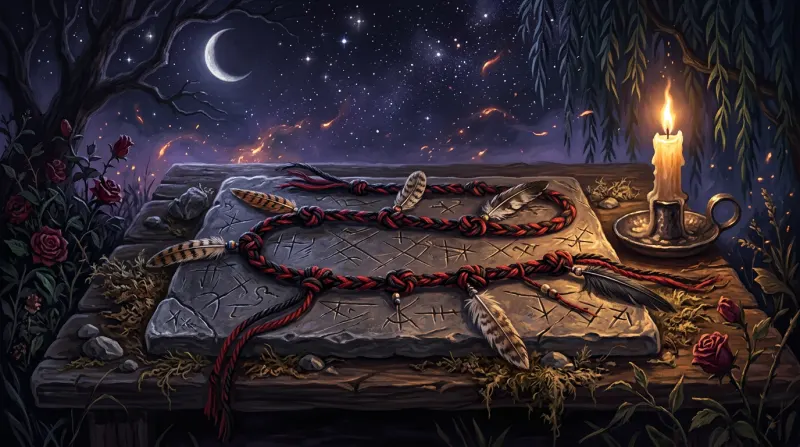
Binding & Release
Knots, cords and tablets. The history of binding, adapted to bind habits, not people.
Binding Spell
A spell that ties up a harmful force so it cannot act. Ancient bindings targeted rivals; the consent-safe modern version binds your own harmful actions or a destructive pattern, never another person.
Breaking the Red Pot: Egyptian Execration
Middle Kingdom Egyptians wrote the names of enemies and dangerous forces on red pots and clay figures, then smashed and buried them to bind those forces. The modern adaptation breaks a pot inscribed with a fear or a bad pattern, not a person.
Cord Cutting Ritual
A modern ritual for letting go of an old attachment: a string joining two candles stands for the tie, and you burn or cut it to mark that you are taking your own energy back. It is a release of your own feelings, not something done to another person.
The Curse Tablet, Turned on a Bad Habit
Romans and Greeks scratched curses on thin lead sheets, folded and pierced them, and gave them to the gods. This is the history, and a safe modern adaptation that binds a bad habit of your own instead of a person.
The Freezer Spell
A modern folk practice that puts a written problem in water and freezes it, to stop something in its tracks. The safe version freezes your own bad habit or the gossip about you, never a named person.
The Poppet
A small figure made to stand for a person, so that what is done to it is done to them. Ancient and early modern poppets were mostly harmful; this entry gives the history and a safe self-focused version for holding yourself steady through a hard season.
The Witch's Ladder and Knot Magic
Tying a wish, a wind or a power into knots is one of the oldest binding methods. This version follows the feathered cord found in a Somerset attic and made famous in 1887, used here to bind a goal into nine knots.
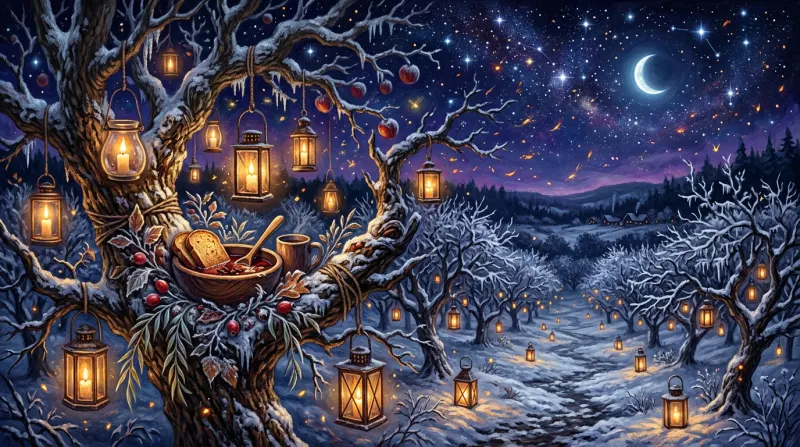
Nature & Seasons
Wassails, bees, midsummer herbs and rain-calling: magic of the land and the year.
Harvest Home and the Last Sheaf
The folk rites of the end of harvest: the last sheaf cut and woven into a corn dolly or neck, carried home with shouting, and kept until spring, followed by the harvest supper. Mabon is a modern Pagan name for the autumn equinox, coined around 1970.
Candlemas Weather Lore and Groundhog Day
The belief that fair weather on Candlemas, 2 February, means winter is not done, told through rhymes and through animals that look at their shadows: the badger in Germany, the bear in Hungary, the hedgehog in Ireland, and the groundhog in Pennsylvania.
The Guy Fawkes Bonfire
The bonfires lit across Britain on 5 November to mark the failure of the 1605 Gunpowder Plot. It is a civic and Protestant commemoration, not a pagan rite, though over four centuries it gathered folk customs of fire, food and community at the turn into winter.
Kupala Night: Herbs, Wreaths and the Fern Flower
On Midsummer night Slavic villagers gathered healing herbs, floated flower wreaths on rivers, leapt over bonfires and searched the forest for the fern that blooms only at midnight. Herbs picked that night were dried and kept as protection all year.
The Lammas Loaf
On 1 August, the first bread baked from the new wheat was blessed, and an Anglo-Saxon charm book directed that it be broken into four pieces and laid in the four corners of the barn to protect the stored grain.
Telling the Bees
When someone in a beekeeping family died, married or was born, a member of the household went to the hives, knocked, and told the bees the news. If the bees were not told, people believed they would leave or die.
Maypole, Beltane Fires and May Dew
The cluster of May Day customs that welcomed summer: raising a decorated maypole, Gaelic Beltane fires that cattle and people passed between for protection, and washing the face in dew on May morning for beauty and health.
Ostara Eggs and Pysanky
Decorating eggs at the spring equinox or Easter to call in spring, fertility and protection, drawing on the Ukrainian pysanka and other wax-resist egg traditions. Ostara itself is a modern Pagan name built on Bede's brief mention of the goddess Ēostre.
Paparuda and Caloian: Calling the Rain
In Romanian and Balkan villages, in drought or in late spring, girls dressed in green leaves danced from house to house while women poured water over them, singing for rain. In the related Caloian rite, children buried and mourned a small clay figure and then sent it down the river to unlock the rain.
Teru Teru Bōzu Weather Doll
A small white cloth or paper doll that Japanese children hang in a window to ask for sunshine; hung upside down it becomes a fure fure bōzu that asks for rain. It is the easiest weather charm in the world to make and has roots in a Chinese broom-lady custom.
St John's Wort on Midsummer Eve
The yellow-flowered herb gathered on St John's Eve (23 June) and hung over doors, stalls and icons to drive off evil spirits, storms and sickness. Its old Latin name fuga daemonum means roughly demon-flight. The plant is also a real medicine with serious drug interactions.
Wassailing the Apple Trees
On Twelfth Night, villagers in the English cider country gather around the oldest apple tree, soak toast in cider for the robins, pour cider on the roots, sing to the tree and make a racket to drive off bad spirits so the orchard bears well.
Wind Knots
Wind knots are cords tied with three knots that were said to hold the wind: undoing the first brought a gentle breeze, the second a strong wind, and the third a storm. Wise women and wizards in Finland, Lapland, Shetland, Orkney and the Isle of Man were reputed to sell them to sailors.
The Yule Log
A large log brought in with ceremony and burned on the hearth at Christmas or the winter solstice, with a piece saved to protect the house and light next year's log. The French bûche de Noël cake is its edible descendant.
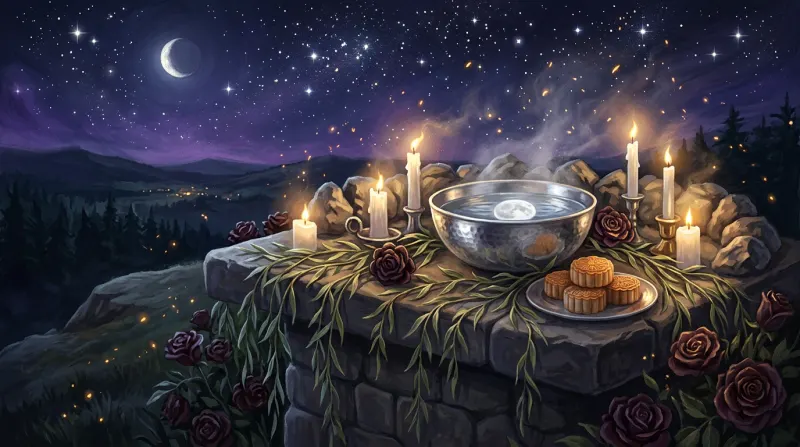
Moon Rites
Full-moon, new-moon and moon-viewing rites from covens, festivals and folklore.
A Full Moon Ritual
A full moon ritual is a simple monthly practice done at home on the night of the full moon to give thanks, release what is finished and charge water or tools in the moonlight. This is a complete solo version for beginners, separate from the Wiccan coven esbat.
A New Moon Ritual
A new moon ritual is a short monthly practice of setting intentions at the start of the lunar cycle, when the moon is dark. It is a modern practice with old roots in new-moon month beginnings, and this version focuses on writing clear, doable intentions.
The Harvest Moon
The Harvest Moon is the full moon closest to the September equinox, so it usually falls in September and sometimes in early October. For a few nights around it the moon rises soon after sunset, giving farmers extra evening light, and its rite is a harvest gratitude meal.
The Beaver Moon
The Beaver Moon is the popular name for November's full moon, recorded by Jonathan Carver for the season when beavers withdraw into their lodges with their winter food stored. Its rite is a home-sealing blessing: tighten up, warm up and settle in.
The Blood Moon
A blood moon is the copper-to-deep-red moon seen during a total lunar eclipse, when the only sunlight reaching it has passed through Earth's atmosphere. It has been read as an omen in many cultures, and this page gives a safe, quiet watching rite for the eclipse night.
The Blue Moon
What a blue moon really is, where the meaning came from, and how modern witches use it: as a rare extra full moon for long-term wishes. The popular rule of the second full moon in a month comes from a 1946 magazine mistake.
The Buck Moon
The Buck Moon is the popular name for July's full moon, from the season when a buck's new antlers are growing fast. Its rite is a growth and strength rite for something you are building up over the summer.
Cakes and Ale
Cakes and Ale is the part of a Wiccan ritual where food and drink are blessed, shared and partly offered back to the gods, usually near the end of an esbat or sabbat. It gives thanks and helps participants ground after magical work.
Eclipse Lore and Eclipse Rites
How people have answered eclipses: Chinese courts and villagers beat drums and pots to drive off the creature eating the sun or moon, Hindu tradition tells of the demon Rahu swallowing them, and modern witches treat eclipses as charged times for endings and resets.
The Cold Moon
The Cold Moon is the popular name for December's full moon, which falls near the winter solstice and rides higher and longer through the night than any other full moon of the year. Its rite is a long-night candle vigil for rest and steady light.
Drawing Down the Moon
A full-moon rite in which a priestess calls the Goddess of the moon into herself and speaks with her voice. Central to Gardnerian and Alexandrian Wicca, named after the old Thessalian witches' boast.
The Flower Moon
The Flower Moon is the popular name for May's full moon, when flowers are blooming across much of North America. Its rite is a planting and beauty blessing, a promise to grow something that feeds bees and people.
Mid-Autumn Moon Offering
Setting a table of round foods, mooncakes and fruit under the full moon of the eighth lunar month to honor the moon and Chang'e and to pray for the family to be whole.
Moon Bathing
Moon bathing is the modern practice of sitting or lying quietly in moonlight, usually near the full moon, to calm down and feel connected to the night sky. It reverses old European folk warnings that sleeping in moonlight could bring madness or blindness.
Moonlit Kheer and Moon Water
Setting food or water out under the full moon so it can take in the moon's light, then sharing it the next day. Rooted in India's autumn full-moon festival; modern witches do the same with water.
The Pink Moon
The Pink Moon is the popular name for April's full moon, named for moss phlox, an early spring wildflower, and not for any pink color in the moon itself. Its rite is a flower blessing for tenderness and new growth.
Equinox Rites of Balance
Customs held at the two equinoxes, when day and night are about equal: the Japanese Buddhist Higan week of grave visits and ohagi sweets, and the Persian new year Nowruz at the spring equinox. Modern Pagans use the days for balance rites.
The Triple Moon Symbol
A full moon flanked by a waxing and a waning crescent, used in modern Wicca and Paganism for the Triple Goddess as Maiden, Mother and Crone. The idea draws on ancient triple goddesses, but this form and meaning were shaped in the 20th century, above all by Robert Graves.
Samhain and Halloween Rites
The old Gaelic start of winter on 31 October to 1 November, kept with bonfires, turnip lanterns, guising, souling for cakes, and divination games. Modern Pagan Samhain rituals for honouring the dead build on these folk customs but are largely a 20th-century reconstruction.
The Esbat
A Wiccan working gathering held on the full moon, separate from the eight seasonal sabbats, for magic, healing work and honoring the Goddess.
The Snow Moon
The Snow Moon is the popular name for February's full moon, recorded by Jonathan Carver in the 1760s for the month with the heaviest snowfall. Its rite is a late-winter rest and restock, honoring the lean time before spring.
The Strawberry Moon
The Strawberry Moon is the popular name for June's full moon, from the season when wild strawberries ripen, and it is one of the few names on the list with a clearly documented Ojibwe counterpart. Its rite is a sweetness and gratitude rite shared over berries.
The Sturgeon Moon
The Sturgeon Moon is the popular name for August's full moon, from the late-summer sturgeon fishing of the Great Lakes region that Jonathan Carver recorded. Its rite is a water and patience rite for long, slow goals, in honor of a fish that can live for many decades.
Tsukimi Moon-Viewing Offering
A Japanese autumn custom of setting out rice dumplings, pampas grass and harvest produce for the full moon and sitting quietly to admire it.
The Supermoon
A supermoon is a full (or new) moon that happens when the moon is near perigee, its closest point to Earth, so it looks somewhat bigger and brighter than usual. The term was coined by astrologer Richard Nolle in 1979, and this page gives a tide-and-intention rite for it.
The Hunter's Moon
The Hunter's Moon is the full moon that follows the Harvest Moon, usually in October, a name English country people were using by 1710. Its rite is a provisioning rite: taking stock, filling the pantry and preparing the household for winter.
Turning Your Silver to the New Moon
On first seeing the new crescent, turning over the coins in your pocket, and in some places bowing to the moon, so your money grows with it through the month.
Winter Solstice: Welcoming the Sun Back
Ways people across the world have kept the longest night and greeted the returning sun: watching dawn enter the tomb at Newgrange, staying up through Persian Yalda Night with pomegranates and Hafez, and eating tangyuan for family reunion at the Chinese Dongzhi festival.
The Wolf Moon
The Wolf Moon is the popular name for January's full moon, the first full moon of the calendar year. The name was spread by American almanacs, and this page gives a quiet midwinter rite for the people you count as your pack.
The Worm Moon
The Worm Moon is the popular name for March's full moon, the last full moon of winter or the first of spring. Its rite is a soil-waking blessing for seeds, gardens and fresh starts.
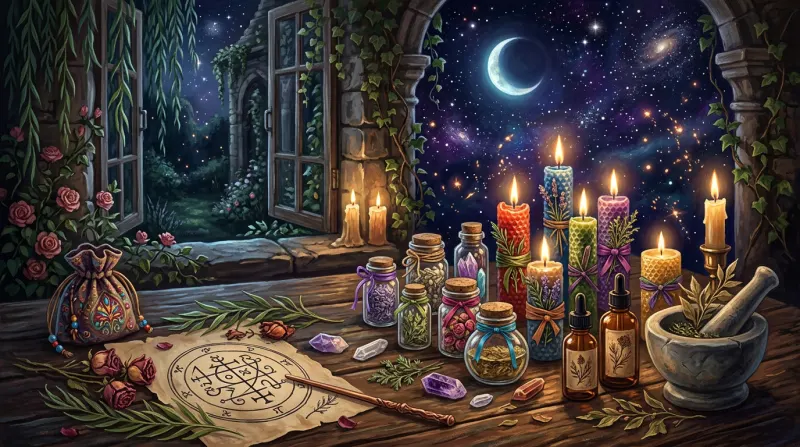
Craft & Tools
Techniques behind the spells: candles, jars, oils, sigils, baths and altars.
The 369 Manifestation Method
A daily writing practice where you write one desire 3 times in the morning, 6 in the afternoon and 9 at night. It is a modern internet method, popular since about 2020, that grew out of the nineteenth-century New Thought movement and its law of attraction.
A First Spell for Beginners
A safe first spell uses a single candle, a bowl of salt water and one clear intention to teach the basic pattern of most folk magic: cleanse, focus, act, and let go. This page also covers how to start practising sensibly and ethically.
The Athame
An athame is a double-edged, usually black-handled ritual knife used in Wicca and modern witchcraft to direct energy, cast and close a circle, and bless the chalice. It is a symbolic tool, traditionally never used to cut anything physical.
The Besom (Witch's Broom)
A besom is a traditional broom made of a bundle of twigs bound to a wooden handle. In folklore it is the witch's flying steed; in modern practice it is used to sweep away stale energy from a room or ritual space, hung over doors for protection, and leapt over at weddings.
Book of Shadows and the Grimoire
A Book of Shadows is a witch's handwritten book of rituals, spells and notes, a term that began with Gerald Gardner's Wicca around 1950. A grimoire is the older name for a book of magic, from the medieval and early modern manuals of conjuration. Today both words describe a personal working journal.
Candle Magic Basics
Candle magic means choosing a candle by colour, dressing it with oil and herbs, stating a clear wish, and letting it burn down while you hold the intention. It is the most common working technique in modern folk magic and the base for hundreds of other spells.
Crown of Success
Crown of Success is a Hoodoo condition formula for achievement, used for exams, job interviews, promotions and performances. It is usually worked as an oil, powder or candle, often with a gold or purple candle and a written goal.
Jar Spell Basics
A jar spell seals a written wish together with herbs, salt, sugar or other symbolic ingredients inside a closed container so the work keeps going for as long as the jar stays closed. It joins two old lines, the English witch bottle and the Hoodoo honey or sugar jar, with a modern craze for small decorative jars.
Mercury Communication Spell
A Wednesday ritual under Mercury to help you say what you mean before a hard talk, a presentation or a letter. It is a modern working that draws on Hermes, deer's tongue in hoodoo, and the Blarney Stone's gift of the gab.
The Mojo Bag
A mojo bag is a small cloth packet holding an odd number of roots, herbs, stones and written petitions, made for one purpose and carried on the body and fed so it keeps working. It is a core tool of African American Hoodoo, and its Louisiana relative is the gris-gris.
Money Drawing Oil
Money Drawing is a Hoodoo condition oil, usually built on cinnamon and other warm herbs, used to dress green candles, wallets, cash registers and mojo bags to pull in income. This version keeps the traditional ingredients but uses safe skin dilution.
Moon Water
Moon water is water left out overnight under the moon, usually the full moon, and then used for cleansing, blessing tools, watering plants or adding to baths. It is a modern pagan practice, though it echoes older customs of exposing food and water to moonlight.
How to Set Up an Altar
An altar is a small dedicated surface holding candles, symbols of the elements and objects meaningful to you, used as the focus for prayer and spellwork. This guide covers the Wiccan layout and simple personal altars, and where the greeting 'blessed be' comes from.
The Ritual Chalice
A chalice is a stemmed cup used in religious ritual. In Christianity it holds the communion wine; in Wicca and modern witchcraft it stands for water, the Goddess and the womb, and is used to share wine or juice and to join with the athame in the symbolic Great Rite.
The Seven-Day Candle
A seven-day candle is a tall candle poured into a glass jar that burns for about a week, used for novenas, prayers to saints and Hoodoo or botánica petitions. The glass makes a long, steady burn possible and gives room for printed prayers or a personal label.
Sigil Magic
A sigil is a personal symbol made by reducing a written wish to an abstract design, charging it with focused attention, and then deliberately forgetting it. The method comes from the English artist Austin Osman Spare and became central to chaos magic.
The Simmer Pot
A simmer pot is a saucepan of water, fruit peel, spices and herbs kept on a low heat to scent and bless a home. It is the signature working of modern kitchen witchcraft, a style of magic built around cooking, the hearth and everyday chores.
The Spiritual Bath
A spiritual bath is an herbal or salt bath taken with prayer to wash off bad luck and heaviness or to draw in good fortune. Hoodoo, Caribbean espiritismo and Japanese Shinto each have their own form.
Van Van Oil
Van Van is an old New Orleans Hoodoo condition oil scented mainly with lemongrass and other fragrant grasses, used to clear bad luck, open the way and empower charms. It is one of the best known oils in Hoodoo and shares its scent family with the cleaning formula called Chinese Wash.
The Witch's Cauldron
A cauldron is a large round cooking pot, usually cast iron and often on three legs, that became the best-known symbol of the witch. In modern practice it is used for brewing simmer pots, burning paper wishes safely, holding water for scrying, and as an altar symbol of the Goddess, transformation and plenty.
The Witch's Familiar
A familiar is a spirit helper believed to assist a witch or cunning person, often in animal form. In early modern English witch trials, familiars such as cats, toads and dogs were treated as evidence of a pact with the Devil; modern witches usually mean a pet or spirit companion they feel a bond with.
The Witch's Mirror
Mirror magic uses a reflective surface either to turn harm back outward, to look inward or into the unseen, or to work on yourself. It ranges from the Chinese bagua mirror over a door to the dark scrying mirror and the modern self-love mirror spell.
Saints & Devotions
Novenas, folk saints, psalms and altars. Living faiths, written about with respect.
The Agnus Dei Wax Medallion
A disc of blessed wax stamped with the Lamb of God, historically consecrated by the pope and kept by Catholics as a sacramental of protection, especially against storms, fire and the dangers of childbirth. The name also belongs to the Lamb of God prayer of the Mass, which these discs illustrate.
The Ancestor Altar
A small, regularly tended shrine where a family remembers its dead with photographs, light, water and offerings, a practice shared in different forms by Chinese, Japanese, Vietnamese, African, Afro-Caribbean, Mexican and modern pagan households.
The Brown Scapular of Our Lady of Mount Carmel
Two small squares of brown cloth joined by cords and worn over the shoulders, a Catholic sacramental that signals a person has entrusted themselves to Mary as Our Lady of Mount Carmel. It is a sign of faith and a commitment to Christian living, not a charm that works on its own.
Burying a Saint Joseph Statue to Sell a House
A popular custom in which home sellers bury a small statue of Saint Joseph in the yard and pray for a quick sale, then dig it up and give it a place of honor in the new home.
Chuseok Ancestral Rite and Songpyeon
Chuseok is Korea's harvest festival on the full moon of the eighth lunar month. Families give thanks to their ancestors with a morning charye table of new-harvest food, tend the family graves, and make half-moon rice cakes called songpyeon for a bright future.
The Day of the Dead Ofrenda
A home altar built for the Mexican Day of the Dead, set with photographs, marigolds, candles, water, salt, pan de muerto and the favorite foods of the dead so that their spirits feel welcome when they return on November 1 and 2.
Guardian Angel and Saint Michael Protection Prayers
Christian protection from evil has long been sought through short prayers to one's guardian angel and to the Archangel Michael, and through older breastplate prayers that wrap the speaker in God's protection.
Kitsune and Inari
Kitsune is Japanese for fox, and in folklore the fox is a clever, shape-shifting spirit that grows more tails with age. In Shinto, white foxes serve as messengers of Inari, the kami of rice, harvest and business, which is why fox statues guard Inari shrines and why fried tofu, the fox's favorite food, is offered there.
The Medal of Saint Benedict
A Catholic sacramental medal showing Saint Benedict on one side and a cross ringed with Latin initials on the other, worn or hung in homes as a prayer for protection against evil and temptation.
Milagros and Ex-Votos
Milagros are small metal charms shaped like body parts, people, animals or objects, pinned to a saint's image to ask for healing or to give thanks; ex-voto paintings tell the story of a miracle in thanks for help received.
The Miraculous Medal
An oval Catholic medal of Mary standing on a globe with rays from her hands, designed after the visions of Saint Catherine Labouré in Paris in 1830 and worn as a sign of trust in Mary's prayers.
The Novena to Saint Jude
Nine days of prayer asking Saint Jude Thaddeus, the Catholic patron of hopeless and difficult causes, to intercede in a desperate situation, traditionally ending with a public thank-you when the prayer is answered.
Obon Welcoming and Sending Fires
Obon is the Japanese Buddhist season, usually in mid-August, when the spirits of ancestors are believed to return home. Families light a small welcoming fire, set out a cucumber horse and an eggplant cow for the spirits' journey, dance the Bon Odori, and send the spirits back with fires and floating lanterns.
Prayer Candles and Written Petitions
The Catholic and wider Christian custom of lighting a small candle before an image of Mary or a saint as a lasting sign of a prayer, often with a written petition left at the shrine or tucked under the candle at home.
Psalm Magic: Praying the Psalms for Help
The practice of reciting chosen psalms for specific needs such as protection, travel, healing or peace at home, found in a medieval Jewish manual and later in Pennsylvania German and African American Hoodoo tradition.
Saint Anthony and Charms for Finding Lost Things
The best-known way to find something lost in the Catholic world is to ask Saint Anthony of Padua for help, often with a short rhyme; other folk traditions add knots, prayers and calm searching rituals.
Saint Cyprian, Patron of Magicians
Cyprian of Antioch, a legendary sorcerer who became a Christian bishop and martyr, is invoked against curses and evil spirits, and his name was attached to famous spell books in Portugal, Spain and Scandinavia.
Saint Expedite, Saint of Urgent Causes
Saint Expedite is a Roman soldier-saint invoked for urgent problems and against procrastination, honored in New Orleans and across Latin America with candles, flowers, a slice of pound cake and a public thank-you.
San Simón (Maximón) of Guatemala
Maximón, also called San Simón or Rilaj Mam, is a Maya folk saint of the Guatemalan highlands whose dressed effigy receives candles, cigars and liquor from people asking for help with health, love, crops and business.
Santa Muerte Devotion
A living Mexican folk devotion to Santa Muerte, a female personification of death honored with candles, rosaries and offerings for protection, healing and a safe passage at death. This page explains what devotees do in public and offers a respectful open practice for outsiders.
The Seven African Powers
The Seven African Powers is a popular image and candle showing seven Catholic saints who stand for seven orishas of Santería (Lucumí), sold in botánicas across the Americas for protection and help. The orisha religion behind it is initiatory, so this page covers its history and an open, respectful way to engage.
Soul Cakes and Souling
Small spiced cakes marked with a cross, given at Allhallowtide to soulers who went door to door singing and promising to pray for the givers' dead. The custom is often named as a forerunner of trick-or-treating.
Hungry Ghost Festival
The fifteenth night of the seventh lunar month, in August or September, when Chinese tradition holds that the gates of the underworld open and wandering spirits visit the living. Families make offerings to their own ancestors and to the hungry ghosts with no one to feed them, and observe customs meant to keep themselves safe through Ghost Month.
Herbs, Stones & Incense
The materials of the craft: herbs, crystals and resins, with their history, lore and safety.
Amethyst
Amethyst is purple quartz, and its Greek name means not drunk: the ancients believed it guarded against drunkenness. Today people treat it as a stone of sobriety, calm and clear thinking, kept by the bed or worn as a reminder.
Black Tourmaline
Black tourmaline is schorl, the most common tourmaline, a glossy black striated crystal. Modern crystal users treat it as the chief protection and grounding stone, set by doors or carried in a pocket; that is belief, though the stone's real electrical properties are fascinating in their own right.
Camphor
Camphor is a waxy white compound with a sharp, cooling smell, taken from the camphor laurel tree or made synthetically. Hindus burn a cube of it as the bright flame of aarti, and Hoodoo and Latin American folk practice use it to purify rooms and clear heavy energy. It is poisonous if swallowed and must be kept away from children.
Citrine
Citrine is yellow to orange quartz. Its modern meaning is prosperity and cheerful confidence, and crystal sellers call it the merchant's stone, but natural citrine is rare and most of what is sold is amethyst that has been heated.
Clear Quartz
Clear quartz, or rock crystal, is the stone that gave us the word crystal: Pliny believed it was ice frozen so hard it could never melt. It is the stone of crystal balls and seeing stones, and modern practitioners treat it as an all-purpose amplifier for intention.
Copal
Copal is the bright, piney tree resin that peoples of Mexico and Central America have burned as a sacred offering for well over a thousand years. Its white smoke still rises over Day of the Dead altars, church doors and village ceremonies, and it can be burned at home with respect as an offering of thanks or remembrance.
Dragon's Blood Resin
Dragon's blood is a deep red resin from several unrelated plants, including the Socotra dragon tree and Southeast Asian rattan palms. Prized since antiquity as dye, varnish and medicine, it is used in Hoodoo and modern witchcraft as a protective, power-boosting incense and as the base of a red ink for writing petitions.
Frankincense
Frankincense is the milky, lemon-and-pine scented resin of Boswellia trees from southern Arabia and the Horn of Africa. It has been burned as a holy offering for thousands of years and is still the classic resin for blessing a room, opening prayer or meditation, and marking a space as sacred.
Tiger's Eye
Tiger's eye is golden brown quartz with a moving silky band of light. Modern crystal users treat it as a stone of courage, focus and protection from the evil eye; the popular claim that Roman soldiers carried it into battle has no ancient source behind it.
Jet
Jet is fossilised wood, a light black gem that Romans in Britain carved into amulets against the evil eye and Victorians wore in mourning. Today people use it as a protective and grieving stone.
Mandrake
The mandrake is a poisonous Mediterranean nightshade whose forked, human-looking root grew a huge body of legend, from the love plants of Genesis to the shrieking root pulled up by a dog. This entry covers the history and gives a safe symbolic working that uses a drawn or carved stand-in, never the real plant.
Moonstone
Moonstone is a feldspar with a soft floating glow called adularescence, and the Romans are said to have thought it was made of moonlight. Today people treat it as a stone of intuition, new beginnings and the feminine cycle, and use it in moon rituals.
Mugwort
Mugwort is a common roadside Artemisia that Europe treated as a guardian herb for over a thousand years: it opens the Anglo-Saxon Nine Herbs Charm and was worn as a girdle on St John's Eve. Today it is best known as a dream herb, tucked into pillows to bring vivid dreams.
Myrrh
Myrrh is the bitter, warm, reddish-brown resin of Commiphora trees from the Horn of Africa and Arabia. Used in Egyptian embalming, Temple anointing oil and the gifts of the Magi, it is burned today for mourning, remembrance, deep prayer and protection, usually blended with frankincense.
Obsidian
Obsidian is natural volcanic glass, prized for razor-sharp blades and polished mirrors. The Aztecs tied obsidian mirrors to Tezcatlipoca, the Smoking Mirror, and John Dee's famous spirit mirror was Aztec obsidian. Today people treat it as a protective and truth-revealing stone.
Palo Santo
Palo santo, Spanish for holy wood, is the fragrant wood of Bursera graveolens, a tree of dry tropical forests from Mexico to Peru. In Ecuador and Peru it is a household and healer's smoke for clearing bad energy, and if you use it, the respectful way is to buy wood gathered from naturally fallen trees and to treat it as someone else's living tradition.
The Pine Cone Symbol
The pine cone has stood for fertility, renewal and long life from Assyrian palace reliefs to the giant bronze Pigna in the Vatican. In folk custom a gathered cone is kept as a charm for luck, abundance and a full house through winter.
Rose Quartz
Rose quartz is pale pink quartz. In modern crystal practice it is the love stone, used for self-kindness, healing after heartbreak and drawing affection; that meaning is mostly 20th-century, though people have carved and worn pink quartz for thousands of years.
Selenite
Selenite is clear crystalline gypsum named from the Greek for moon. People today treat it as a cleansing and calming stone that clears the energy of other crystals; that is a belief, and it is a very soft mineral that should be kept away from water.
Vervain
Vervain is a slender wild verbena that the Romans counted among their holiest plants: Pliny says it was carried by envoys, used to cleanse the table of Jupiter and swept through houses to purify them. Modern practitioners still use it as a cleansing and protective herb.
No spells match that.
Try fewer filters, or request a custom spell.
Can't find the one you need?
Tell us what is going on and we will craft a spell for it.