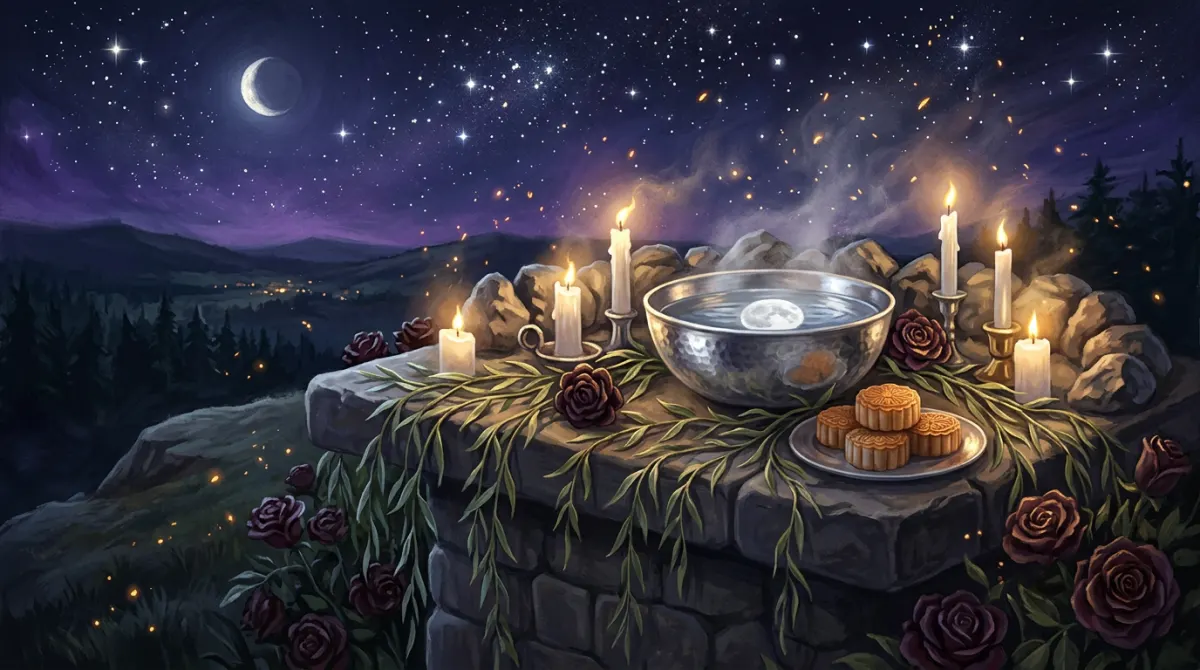
A Wiccan working gathering held on the full moon, separate from the eight seasonal sabbats, for magic, healing work and honoring the Goddess.
TraditionWicca
RegionEngland, then worldwide
Era20th century
Moon○ Full moon
DayMoon
ElementSpirit
Difficulty●●○ Moderate
Time1 to 2 hours
Tonight's moon is read when the page loads.
The working
Choose the night of the full moon and gather in a safe, clear space.
Sweep the space, then sprinkle salted water around its edge to mark the circle.
Light the quarter candles, greeting each direction.
Honor the moon with a reading, chant or silence.
Do the working: each person names a healing, a task or a hope.
Share cakes and drink, setting a little aside for the earth.
Thank the directions in reverse order, put out the candles and open the circle.
Take care: Keep candles on stable holders, never leave flames unattended, and if wine is shared offer a non-alcoholic choice.
Versions across time and place
i
Murray's esbat
Folklore scholarship · 1921
Murray borrowed the word from a French witch-trial record and used it for the small local meetings she believed witches held for business and magic, as distinct from the great Sabbaths. Her theory of a surviving pagan witch-cult has been rejected by historians, but the word stuck.
Recorded in: Margaret Murray, The Witch-Cult in Western Europe (1921)
ii
The thirteen moons of the coven
Gardnerian and Alexandrian Wicca · 1950s onward
Valiente and others fixed the esbat on the full moon, giving thirteen meetings in most years alongside the eight sabbats. Coven esbats combine ritual, magical work, teaching and the cakes-and-wine meal.
Recorded in: Doreen Valiente, An ABC of Witchcraft Past and Present (1973)
iii
Solitary esbat
Eclectic and solitary Wicca · 1988 onward
Cunningham's widely read guide adapted the coven forms for people practicing alone. The full-moon rite became a short personal circle with a lunar invocation and a working, often just a candle and an intention.
Recorded in: Scott Cunningham, Wicca: A Guide for the Solitary Practitioner (1988)
History
The word esbat came into English through Margaret Murray, an Egyptologist, who in The Witch-Cult in Western Europe (1921) took it from a French trial source and suggested a link to Old French s'esbattre, to frolic. She described esbats as small local meetings of witches, as opposed to the large seasonal Sabbaths. Murray's evidence came mostly from witch-trial confessions, read very selectively.
Murray's history is discredited, but Gardner and Valiente adopted her vocabulary in the 1950s, and Wicca settled on the full moon as the esbat night. With the eight sabbats it forms the Wiccan ritual calendar. Solitary practice, popularized in the 1980s by Scott Cunningham, made the esbat a common personal ritual. Many covens today still meet monthly on or near the full moon.