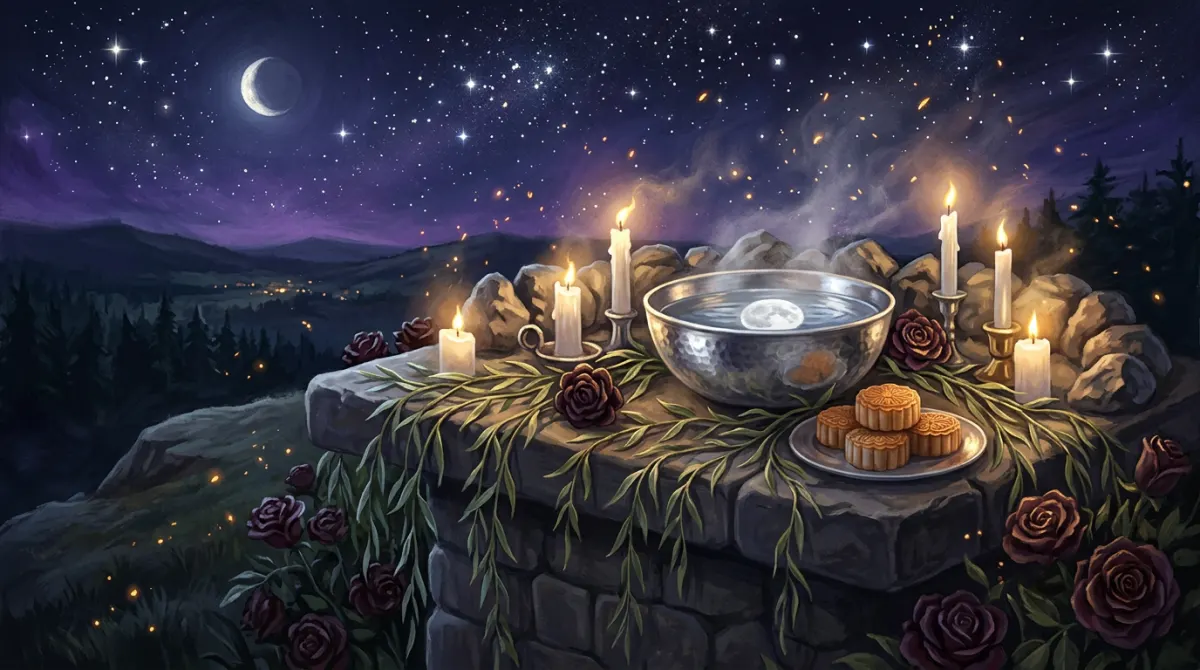
Also called February full moon, Hunger Moon, Bear Moon
The Snow Moon is the popular name for February's full moon, recorded by Jonathan Carver in the 1760s for the month with the heaviest snowfall. Its rite is a late-winter rest and restock, honoring the lean time before spring.
TraditionNorth American almanac lore and modern seasonal practice
RegionNorth America (northern hemisphere)
Era1760s records; popularized 1930s onward
Moon○ Full moon
DayMoon
ElementWater
Difficulty●○○ Simple
Time30 to 45 minutes on the night of the full moon. It falls in February in the northern hemisphere; the next one is in February 2027.
Tonight's moon is read when the page loads.
The working
On the night of the February full moon, bring in a bowl of clean snow, or fill a bowl with cold water.
Light the candle beside it and sit quietly while you look at the moon or its light on the ground.
Name what has run low this winter: energy, money, patience, food in the cupboard. Write each one down.
Set the pantry staples next to the bowl and say what you will do to restock one of those low places this month.
Set aside some of the staples, or the money they cost, for a food bank or a neighbor who is short this season.
When the snow has melted, water a houseplant or the ground outside with it, put out the candle and follow through on your gift.
Take care: Keep any candle on a fireproof dish and never leave it burning unattended. If you go outside at night, dress for the weather, take a light and tell someone where you are. Moon names tied to specific Native nations belong to living languages and ceremonies. Read them as those nations' own knowledge, not as rites to copy; the steps here are an open seasonal practice anyone can do.
Versions across time and place
i
Carver's Snow Moon
18th-century traveler's account · 1760s, published 1778
Carver's list, gathered while he wintered among Dakota bands he called Naudowessies, names February the Snow Moon because the most snow falls then. The Old Farmer's Almanac credits the name to the Dakota through Carver.
Recorded in: Jonathan Carver, Travels Through the Interior Parts of North America (1778)
ii
Hunger and Bony Moon
Cherokee, as listed by the Old Farmer's Almanac · recorded 20th century
The almanac lists Cherokee names for this moon meaning Bony Moon and Hungry Moon, pointing to how thin the food stores could get by late winter. Names like these are a reminder that February was often the hardest month to get through.
Recorded in: The Old Farmer's Almanac, Full Moon Names
iii
Namebini-giizis and Mkwa-giizis
Ojibwe (Anishinaabe) · living tradition
Ojibwe language sources give February names including Sucker Moon (Namebini-giizis), Bear Moon (Mkwa-giizis) and Crust-on-the-Snow Moon. They track what was happening on the land and in the water, and vary from one community to the next.
Recorded in: Ojibwe.net, Months / Moons
History
In 1778 the Connecticut-born explorer Jonathan Carver published the moon names he had heard during his travels west of the Great Lakes in 1766 to 1768. February in his list is the Snow Moon, the month when the most snow falls. His book sold widely in Europe and America, and his names fed later collections, including the fraternal Improved Order of Red Men in the 19th century and the 1930s Maine Farmers' Almanac.
Today the Snow Moon headline comes mostly from the Old Farmer's Almanac and from news coverage built on it. The almanac also lists other nations' names for the same month, such as Bear Moon for the Ojibwe and Hungry Moon for the Cherokee. These names come from different peoples and climates, and each one belongs to its own calendar rather than to a single shared Native list.