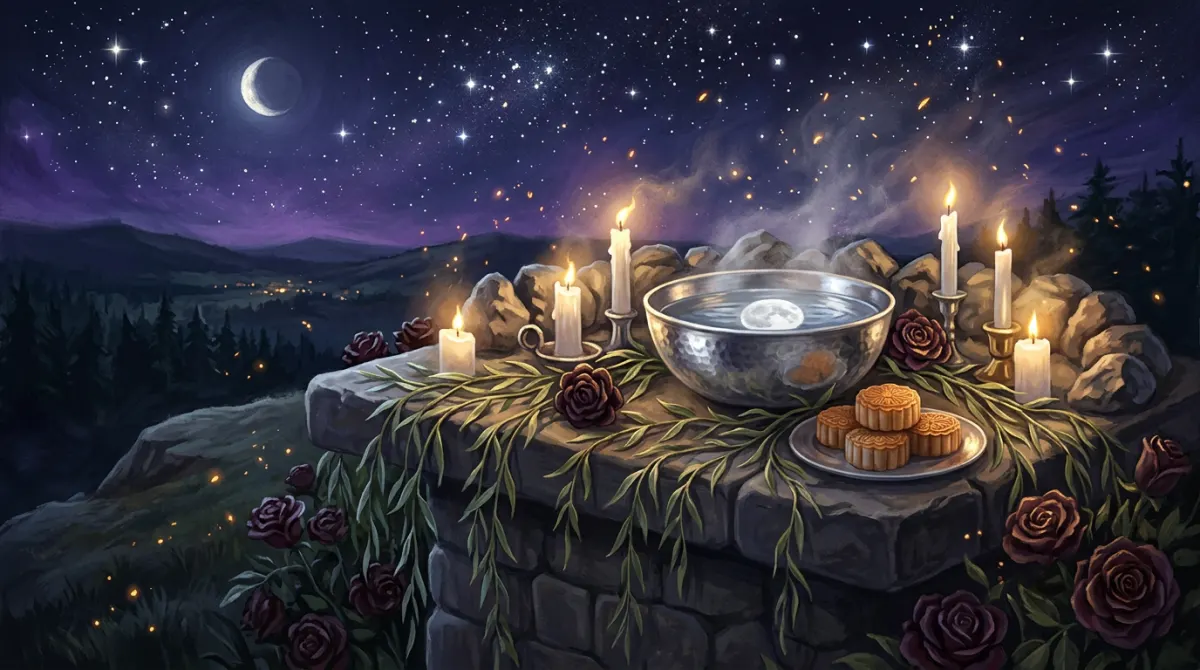
Also called full moon release ritual, full moon ceremony at home
A full moon ritual is a simple monthly practice done at home on the night of the full moon to give thanks, release what is finished and charge water or tools in the moonlight. This is a complete solo version for beginners, separate from the Wiccan coven esbat.
TraditionModern pagan and eclectic practice, drawing on older full-moon observances
RegionWorldwide
Era20th century to present
Moon○ Full moon
DayMoon
ElementWater
Difficulty●○○ Simple
Time30 to 60 minutes
Tonight's moon is read when the page loads.
The working
Tidy the room or the patch of yard you will use, open a window or curtain toward the moon, and set out your things.
Sit, breathe slowly for a few minutes and light the candle, saying a simple greeting to the full moon in your own words.
On the first slip, write what has come to fullness this month: things finished, received or learned, and say thanks for each.
On the second slip, write what you are ready to release: a habit, a grudge, a worry, an old plan.
Burn the release slip carefully in the fireproof bowl, or tear it into small pieces, and say that you let it go.
Set the jar of water and any stones where the moonlight falls to charge overnight.
Sit for a few more minutes in quiet, then thank the moon, put out the candle and keep the thanks slip in a journal.
In the morning bring in the jar and use the water through the month for plants, washing your hands before a task, or a cleansing wipe of your doorway.
Take care: Burn paper only in a fireproof bowl on a stable surface, away from curtains, with water nearby. Do not drink water left out overnight unless it was in a clean, covered container and you are confident it is safe.
Versions across time and place
i
Uposatha
Theravada Buddhism · ancient to present
Buddhists keep Uposatha on full and new moon days, and in some places the quarter moons too. Lay followers take the Eight Precepts for a day and night, visit the temple, make offerings, listen to teaching and meditate.
Recorded in: Wikipedia, Uposatha
ii
Purnima observances
Hindu calendar · ancient to present
In the Hindu calendar the full moon day, Purnima, is the setting for many festivals and fasts, and some days such as Guru Purnima honor teachers. Practices differ by region and community.
Recorded in: Wikipedia, Full moon
iii
The Wiccan esbat
Wicca · 1950s onward
Wiccans hold esbats on the full moon, with a cast circle, invocations and the cakes-and-wine meal. Scott Cunningham's 1988 guide adapted it for solitary practitioners. This page's ritual is simpler and does not require circle-casting or a specific deity.
Recorded in: Wikipedia, Esbat; Scott Cunningham, Wicca: A Guide for the Solitary Practitioner (1988)
History
People have marked the full moon for as long as there are records. In Buddhist countries the full and new moon days are Uposatha, kept since early times with precepts and temple visits. In the Hindu calendar Purnima, the full moon day, carries many festivals and fasts, and some Chinese Buddhists eat vegetarian on new and full moon days. Before electric light, the full moon was also simply the night when people could travel, work and gather after dark.
The modern home full moon ritual comes mostly from 20th-century Wicca, where the full moon esbat was fixed by Doreen Valiente and others in the 1950s, and from the solitary-practice books of the 1980s. Since the 2010s it has spread through wellness and astrology media as a monthly practice of gratitude, release and charging moon water, often done alone in a few minutes.