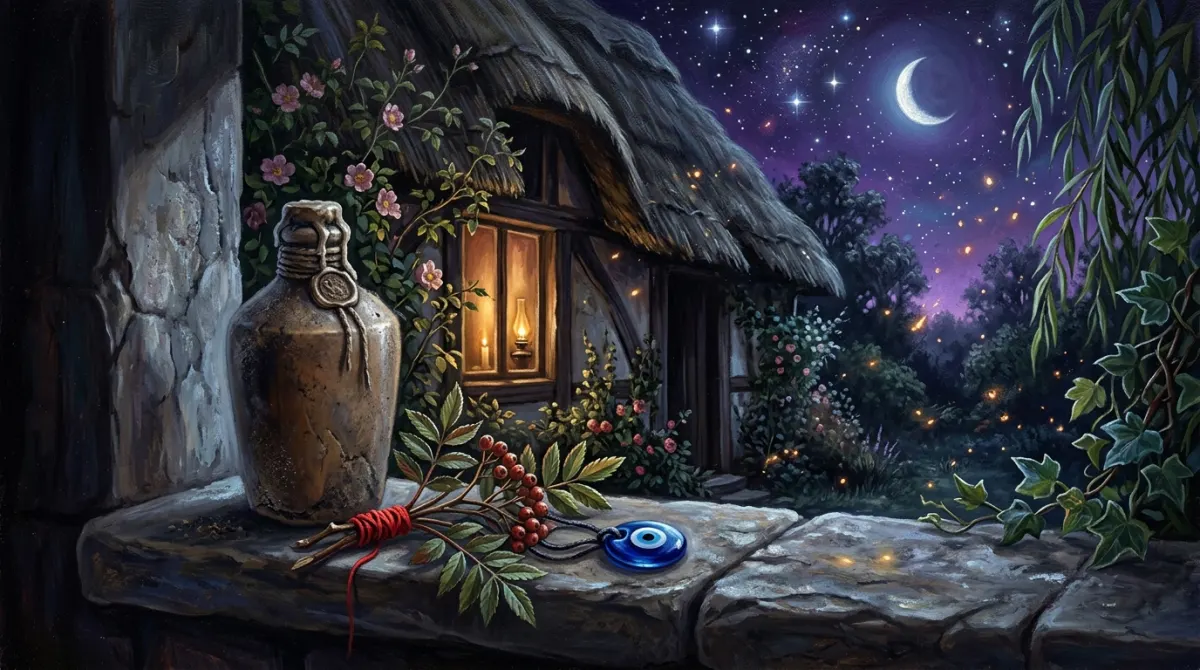
Also called rowan tree and red thread, crosh cuirn, witch-wood cross
Two rowan twigs bound into an equal-armed cross with red thread and placed over doors, byres and cradles to keep witches and fairies out.
TraditionScottish Highland and Lowland folk custom
RegionScotland
Era17th to 19th century
Moon◐ Any moon
DayAny
ElementEarth
Difficulty●○○ Simple
Time15 minutes
Tonight's moon is read when the page loads.
The working
Ask permission of the tree in your own words and break, rather than cut, two small twigs; many accounts insist no knife or iron be used.
Lay one twig across the other to make an equal-armed cross.
Wind the red thread around the join in an X pattern several times, binding the twigs firmly.
While winding, you may say the old rhyme: rowan tree and red thread, put the witches to their speed.
Tie the thread off and leave a short tail.
Fix the cross over the house door, the byre or stable door, or tuck it into a coat lining or pocket.
Renew it each year, traditionally on May Eve or Beltane, and burn or bury the old one.
Take care: Rowan berries are mildly toxic raw; do not eat them, and keep berries away from small children. Take only a little from any tree and only with the landowner's permission.
Versions across time and place
i
The Manx crosh cuirn
Isle of Man · 19th century
On May Eve Manx families made small crosses of rowan, called crosh cuirn, without using a knife, and fixed them over doors and to the tails of cattle. They were worn by people too, and were meant to hold off the fairy and witch activity believed to peak on the eve of summer.
Recorded in: Trees for Life, 'Rowan: Mythology and Folklore'
ii
Rowan in the byre and the milk
Scottish Highlands · 19th century
Highland households used rowan to guard the dairy, stirring milk with a rowan rod or fixing rowan to the churn so the butter would not be stolen by charms. Rowan was also burned or set at the byre threshold on May Day and Hallowmas, the two hinges of the pastoral year.
Recorded in: Alexander Carmichael, Carmina Gadelica (1900)
iii
The red thread as evidence
Ayrshire witch trial · 1618
The charm was common enough that a rowan twig tied with red thread was produced as damning evidence against a woman tried for witchcraft in Ayrshire in 1618. The rhyme survived in several forms that Robert Chambers collected in the nineteenth century, showing the habit outlived the trials.
Recorded in: Trees for Life; Robert Chambers, Popular Rhymes of Scotland (1826, later editions)
History
Rowan, Sorbus aucuparia, grows across upland Scotland and was the classic witch-wood of the north. Its bright red berries each carry a tiny five-pointed star at the base, and red was widely held to be a colour that witches and fairies could not abide. Binding rowan with red thread joined the two strongest protections in one small object. Crosses were fixed over doors and byres, plaited into cows' tails and sewn into clothing.
Robert Chambers printed the rhyme 'rowan tree and red thread' in his Popular Rhymes of Scotland, first issued in 1826, alongside variants from the north-east. Alexander Carmichael's Carmina Gadelica, gathered in the Gaelic-speaking Highlands and Islands and published from 1900, records rowan used at the turning points of the year. The custom spread south into northern England and Cornwall, and many families still hang a rowan sprig over the door each spring.