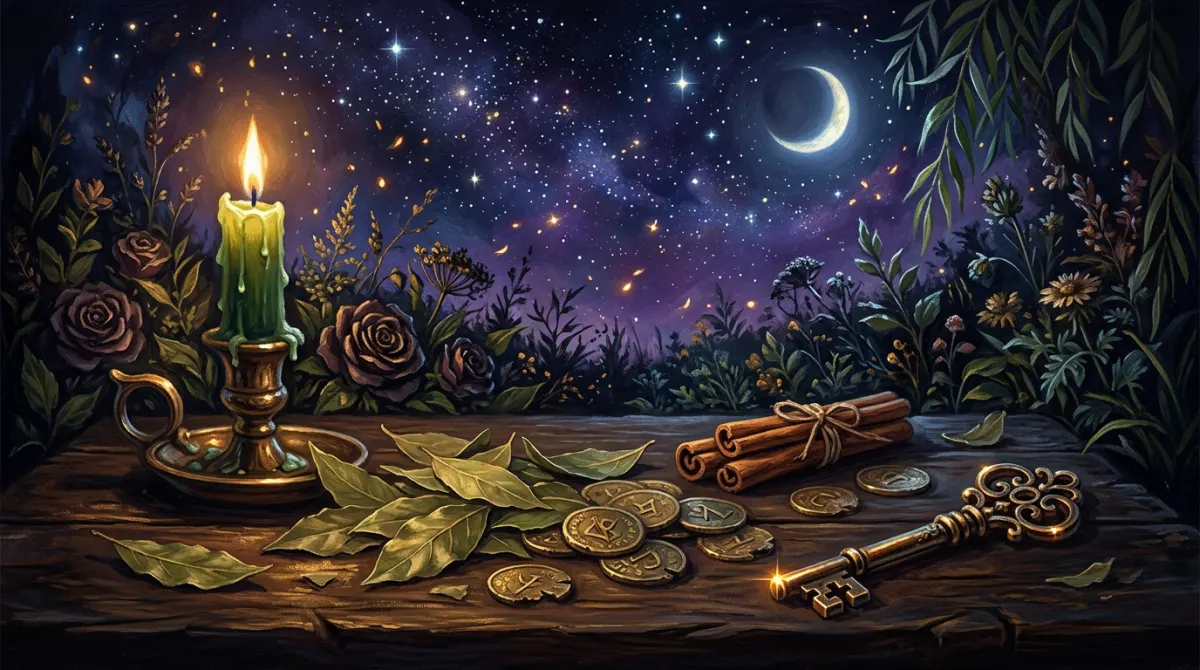
Also called money bowl, prosperity bowl, abundance spell bowl
A bowl filled with grain, coins, herbs and a written intention, kept on a shelf and added to over time so wealth 'gathers' like the contents. The money-bowl form is modern, from the 2010s, with older full-vessel customs behind it.
TraditionModern witchcraft, drawing on older vessel customs
RegionNorth America and Europe (online practice)
Era2010s; older versions much earlier
Moon☽ Waxing moon
DayThursday · Jupiter
ElementEarth
Difficulty●○○ Simple
Time30 minutes, then tended monthly
Tonight's moon is read when the page loads.
The working
Write your intention as if already true, such as 'My household has enough and to spare.' Sign and fold it.
Pour a layer of rice into the bowl and lay the paper in it.
Add the coins and note, then the cinnamon, bay and basil, saying what each brings as you add it.
Set the crystal on top. If you use a candle, burn it beside the bowl, not in it.
Place the bowl somewhere you see daily, often near the front door or in the kitchen.
Add a coin whenever you can, and on each new or full moon say your intention again.
When the bowl feels finished or the goal is met, spend the coins on something useful and compost the herbs and rice.
Take care: Keep candles beside the bowl, never in dry herbs, and never unattended. Respect Hindu kalash worship as a living devotion rather than copying its consecration.
Versions across time and place
i
The Lakshmi kalash
Hindu worship, Varalakshmi Vratam and Diwali · Ancient to present
A brass or copper pot holding water or rice, coins and turmeric, crowned with mango leaves and a coconut, becomes the seat of the goddess Lakshmi for the day of worship. It is a living devotion, so the open bowl above borrows the idea of a full vessel, not the rite itself.
Families top up the rice jar before New Year's Eve and never let it run empty over the holiday, since an empty jar foretells a lean year. Some add coins or red paper.
Uses: rice jar, rice, coins
Recorded in: Asian Inspirations, 'Asian New Year superstitions and taboos'
iii
The feng shui wealth bowl
Modern feng shui practice · Late 20th century
A bowl of coins, crystals and symbols placed in the 'wealth corner' of a home. Practitioners writing about money bowls suggest it was a direct model for the modern witchcraft version.
Uses: bowl, coins, crystals
Recorded in: Otherworldly Oracle, 'Money Bowls'
History
The money bowl as practised today is recent. It spread through witchcraft blogs and social media in the 2010s, and even writers who teach it say they cannot find a single older source. It mixes the feng shui wealth bowl, the manifestation habit of writing goals as if achieved, and Hoodoo-style use of money herbs. Saying this plainly does not make it less useful; it simply places it correctly.
The idea underneath, that a full vessel invites fullness, is old and widespread. In Hindu worship the kalash, a pot of water or grain, coins and leaves, is the seat of the goddess Lakshmi during Varalakshmi Vratam in South India and at Diwali. Chinese households keep the rice jar full at New Year. Europeans set out bowls of grain, nuts and coins at the turning of the year. The modern bowl inherits that logic.