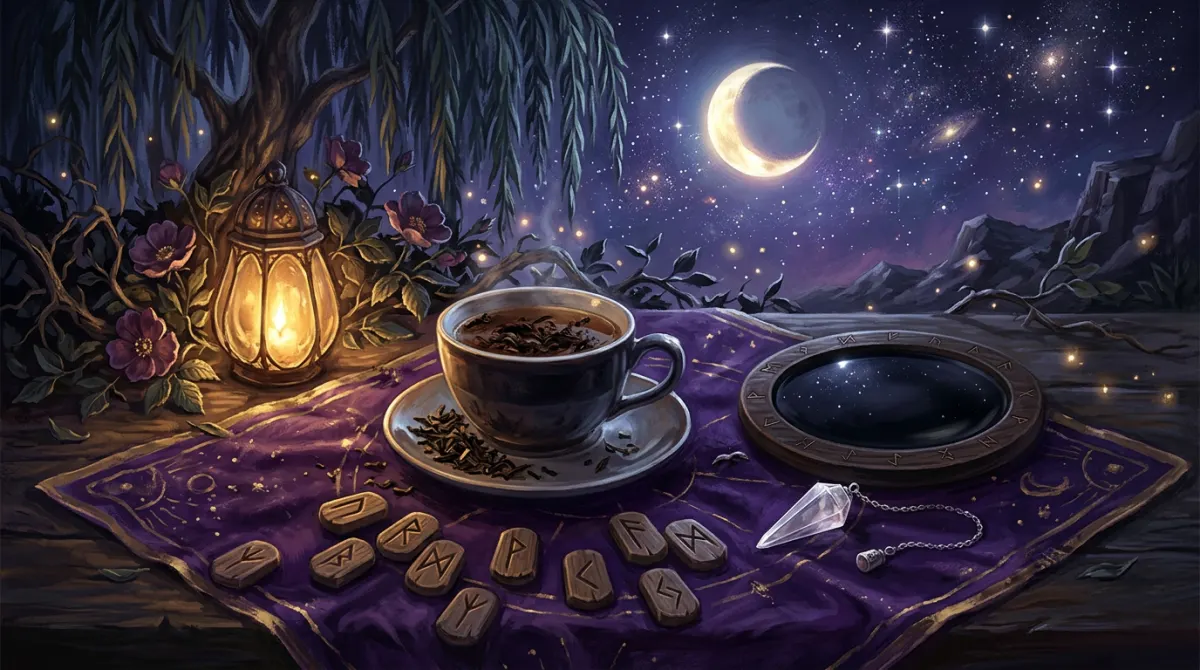
Marking slips of wood with signs, scattering them on a white cloth and reading the ones you pick up. Built from Tacitus's account of Germanic lot-casting and modern rune practice.
TraditionGermanic lot-casting as described by Tacitus, with modern runic reconstruction
RegionNorthern Europe
Era1st century CE (Tacitus); modern revival from the 20th century
Moon◐ Any moon
DayWednesday · Mercury
ElementEarth
Difficulty●●○ Moderate
Time1 hour to make, 15 minutes to read
Tonight's moon is read when the page loads.
The working
Cut the twig into small, even slips, enough for your signs.
Mark each slip with a sign; most people today use the 24 letters of the Elder Futhark.
Spread the white cloth on the floor or table.
Hold your question in mind, look up, and scatter the slips across the cloth.
Without looking down, pick up three slips one at a time.
Read them in order: the situation, what helps or hinders, what is likely.
If the answer feels unclear, Tacitus's rule was to wait and not ask again that day.
Take care: Cut away from your hand and use only fallen or pruned wood. Some modern hate groups misuse runic symbols; heathen organizations ask that runes be used without that baggage.
Versions across time and place
i
The lots in Tacitus's Germania
Early Germanic peoples · 98 CE
Tacitus says the Germans cut a branch of a fruit-bearing tree into slips, marked them with signs, and scattered them on a white cloth. A priest for public questions, or the father of the household for private ones, prayed, looked to the sky, and took up three slips to read. An unfavorable result closed the question for that day. He does not say the signs were runes, which are first attested about a century later.
Recorded in: Tacitus, Germania, chapter 10
ii
Shaking the twigs in Hymiskviða
Old Norse poetry · Codex Regius, 13th century; older material
The poem opens with the gods shaking divining twigs (teinar) and examining blood to learn what they should do. It is one of the few Norse texts to mention lot-casting and gives no detail of the method.
Recorded in: Poetic Edda, Hymiskviða, stanza 1
iii
The modern rune set
20th-century Western esotericism · 1982
Blum's boxed set of clay runes with a guidebook made rune-casting a popular oracle in the English-speaking world. It added a blank rune and meanings drawn from his own reading, which historians and many heathen practitioners regard as invention. Earlier, the Austrian occultist Guido von List had built his own 18-rune system in 1908.
Recorded in: Ralph Blum, The Book of Runes (1982)
History
Runes are an alphabet, first carved around 150 CE, used for names, memorials and charms. There is no surviving Viking-age description of runes being cast for fortune-telling. What survives is Tacitus's short account, from 98 CE, of marked slips scattered on white cloth, and a few Eddic hints of shaking twigs. Runes did appear on amulets and in charms, so their link with magic is real, but not as a deck of fortune-telling lots.
Modern rune-casting therefore joins Tacitus's method to the runic letters. Guido von List in 1908 and Ralph Blum in 1982 each built influential systems, and heathen groups today work from the Old English, Norwegian and Icelandic rune poems for meanings. The honest label is reconstruction, which many practitioners accept openly. Treating the method as a modern practice built on old fragments keeps it both usable and truthful.