Also called Zhongqiu Jie, Moon Festival, baiyue (worshipping the moon)
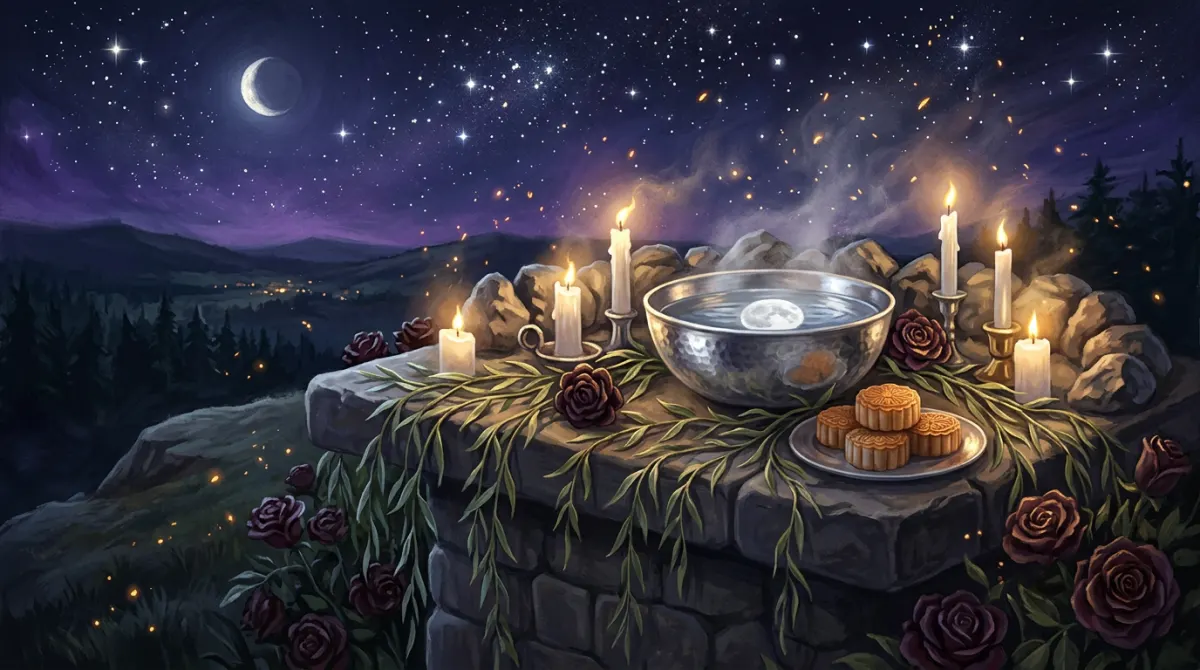
Setting a table of round foods, mooncakes and fruit under the full moon of the eighth lunar month to honor the moon and Chang'e and to pray for the family to be whole.
TraditionChinese Mid-Autumn Festival
RegionChina
EraTang and Song dynasties to today
Moon○ Full moon
DayMoon
ElementWater
Difficulty●○○ Simple
TimeAn evening
Tonight's moon is read when the page loads.
The working
On the 15th day of the eighth lunar month, set a small table where the rising moon will be visible.
Arrange mooncakes and round fruit on it, round shapes standing for wholeness and reunion.
As the moon rises, light the candle or incense and bow to the moon.
Make a quiet wish for family members, especially those far away.
Sit with family and drink tea while watching the moon, telling the story of Chang'e.
Afterwards cut the mooncakes into as many pieces as there are people and share them.
Take care: Keep candles and incense away from paper lanterns, and supervise children with lanterns that use real flames.
Versions across time and place
i
Song dynasty moon-viewing
Northern Song China · 12th century
Meng Yuanlao's memoir of the Northern Song capital Kaifeng describes Mid-Autumn night, with wealthy families decorating pavilions and townspeople crowding wine shops to view the moon until dawn. By then the festival was a fixed part of the city calendar.
Recorded in: Meng Yuanlao, Dongjing meng hua lu (1147)
ii
Women's moon altar
Late imperial China · Ming and Qing
In many households the moon offering was women's work, summed up in the old saying that men do not worship the moon and women do not sacrifice to the Kitchen God. Women and girls bowed at the moon table and prayed for beauty, a good marriage or children.
Recorded in: Folk saying recorded in Chinese festival studies
iii
Tết Trung Thu
Vietnam · Living tradition
In Vietnam the festival became mostly a children's night, with star lanterns, lion dances and a moon-viewing feast. The tray of fruits and mooncakes is often shaped into figures, and the moon lady and the man in the moon, Chú Cuội, take Chang'e's place in stories.
Recorded in: Vietnamese Mid-Autumn customs
History
Chinese court rites to the moon in autumn go back to the Zhou period, but a popular Mid-Autumn festival took shape in the Tang dynasty (618 to 907), when poets wrote about the bright moon of the eighth month. In the Song (960 to 1279) it became a city festival of moon-viewing, feasting and offerings. Officials and scholars held moon-viewing banquets, and ordinary families set out food and incense.
The myth of Chang'e, who drank the elixir of immortality and rose to the moon where she lives with a jade rabbit, became attached to the night, and mooncakes became its signature food by the Ming. Today it is a public holiday in China, Taiwan, Hong Kong and elsewhere, kept as a night of family reunion. In Korea the same full moon is Chuseok, a harvest festival centered on ancestors.