Also called May full moon, Milk Moon, Planting Moon
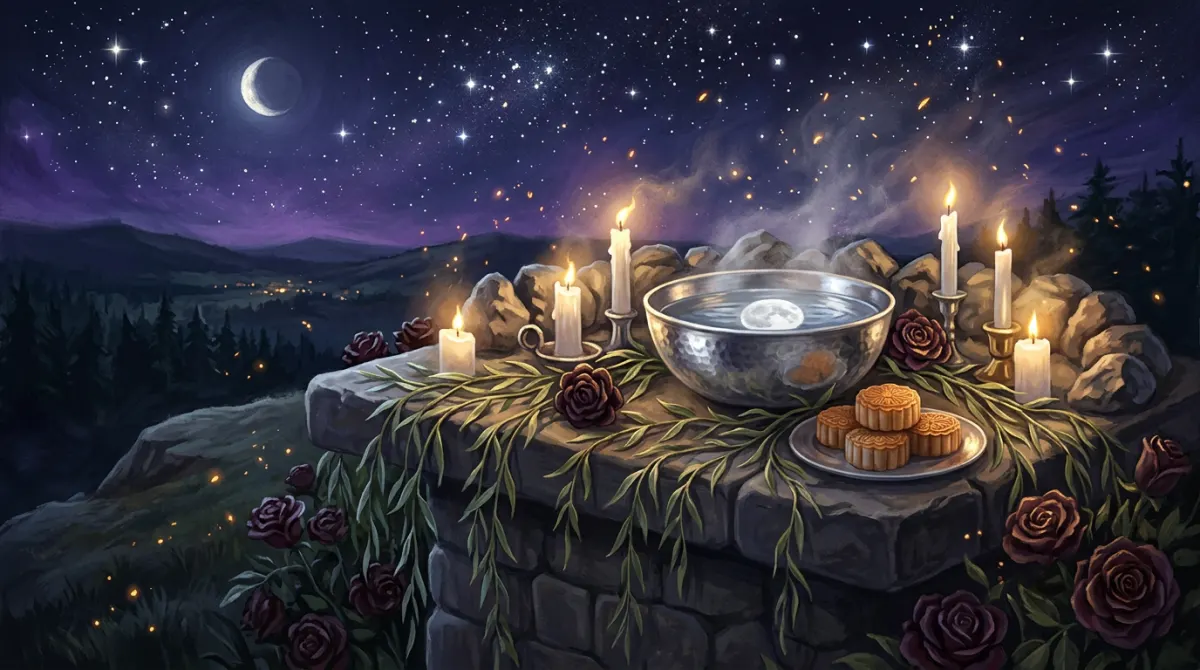
The Flower Moon is the popular name for May's full moon, when flowers are blooming across much of North America. Its rite is a planting and beauty blessing, a promise to grow something that feeds bees and people.
TraditionNorth American almanac lore and modern seasonal practice
RegionNorth America (northern hemisphere)
Era1760s records; popularized 1930s onward
Moon○ Full moon
DayMoon
ElementEarth
Difficulty●○○ Simple
Time30 to 45 minutes on the night of the full moon. It falls in May in the northern hemisphere; the next one is in May 2027.
Tonight's moon is read when the page loads.
The working
On the evening of the May full moon, take the plant or seeds outside or to a sunny windowsill.
Plant them, or choose the spot where they will go, and water them from the bowl.
Write three things in your life that are in bloom right now and one thing you hope to bring into flower.
Wear the bloom or crown while you look at the moon, and thank the flowers, bees and gardeners who feed you.
Say your hope aloud, then keep the paper in a book until summer and see what has grown.
Water the new plant each week as a small, repeated promise.
Take care: Keep any candle on a fireproof dish and never leave it burning unattended. If you go outside at night, dress for the weather, take a light and tell someone where you are. Moon names tied to specific Native nations belong to living languages and ceremonies. Read them as those nations' own knowledge, not as rites to copy; the steps here are an open seasonal practice anyone can do.
Versions across time and place
i
Carver's Month of Flowers
18th-century traveler's account · 1760s, published 1778
Carver gave May as the Month of Flowers in his 1778 list. It is one of the few current popular names that matches his wording closely.
Recorded in: Jonathan Carver, Travels Through the Interior Parts of North America (1778)
ii
Milk Moon and Hare Moon
European almanac usage · 1937 print and later
The 1937 Maine Farmers' Almanac called one spring moon the Milk Moon. Patricia Haddock suggested in 1992 that names like Milk Moon and Hare Moon for May have European roots, from the season of spring calves and hares.
Recorded in: Wikipedia, Full moon, citing the 1937 Maine Farmers' Almanac and Patricia Haddock's Mysteries of the Moon (1992)
iii
Waabigwani-giizis, Flower Moon
Ojibwe (Anishinaabe) · living tradition
Ojibwe language resources give May names such as Waabigwani-giizis, Flower Moon, Zaagibagaa-giizis, Budding Moon, and a Planting Moon. Here the popular English name lines up with a documented Ojibwe one.
Recorded in: Ojibwe.net, Months / Moons
History
May's full moon is called the Flower Moon in the Old Farmer's Almanac, which notes the name was used by Algonquin and Ojibwe peoples. Ojibwe language sources do record a flower moon for May, Waabigwani-giizis. Jonathan Carver's 1778 list also called May the Month of Flowers, so this is one of the better-supported names on the popular list, with roots in more than one record.
Other names for the same moon point to farm work and young animals. The almanac lists Planting Moon for the Dakota and Lakota and Egg Laying Moon for the Cree, while European usage gave Milk Moon and Hare Moon. The May full moon falls close to May Day celebrations in Britain and Europe, with their flowers, maypoles and early-morning dew-gathering.