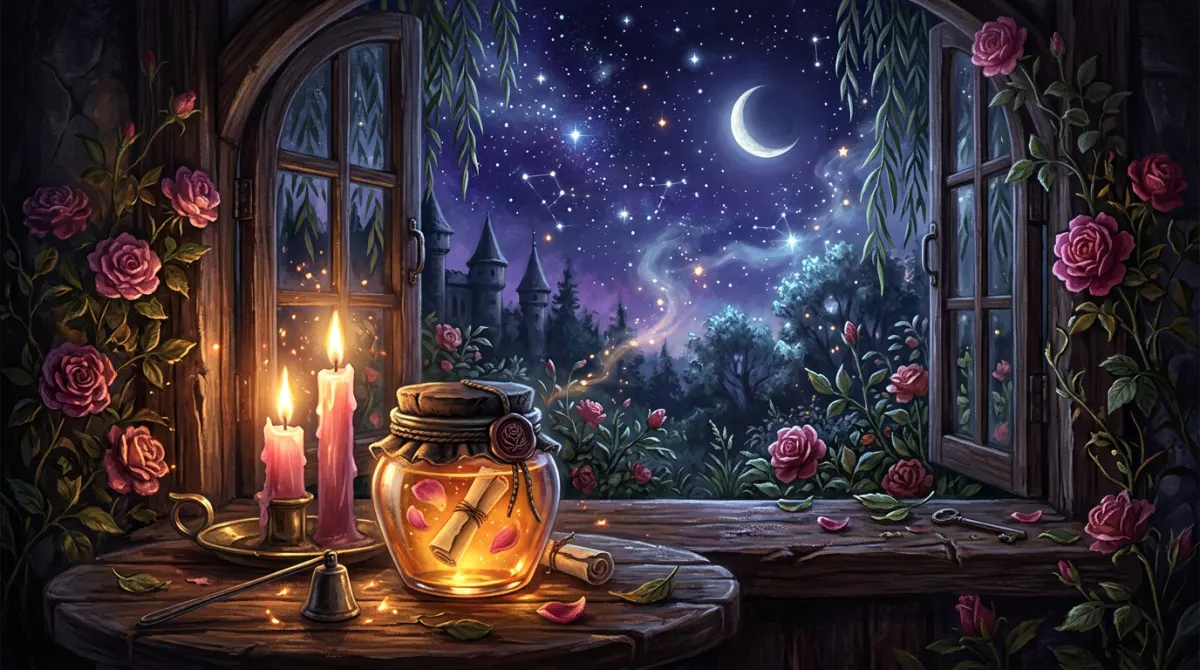
A small cloth pouch of dried rose petals and sweet herbs, carried or kept by the bed to open yourself to love. It is the gentle modern descendant of a very old and much harsher line of Greek and Egyptian love magic.
TraditionModern Western folk magic and Wicca, drawing on Greco-Egyptian love charms
RegionMediterranean origins; modern Britain and North America
EraAncient roots (3rd century BCE to 5th century CE); modern form 20th century
Moon☽ Waxing moon
DayFriday · Venus
ElementWater
Difficulty●○○ Simple
Time15 minutes, refreshed monthly
Tonight's moon is read when the page loads.
The working
On a Friday in the waxing moon, set out your cloth and herbs on a clean table.
Hold the rose petals in your palms and say what kind of love you want to grow, for example 'kindness given and returned'. Describe qualities, not a named person.
Place the petals, lavender and orris or vanilla in the middle of the cloth, with the stone if you use one.
Gather the corners and tie them with the red thread in three knots, repeating your wish at each knot.
Breathe on the sachet once to give it life, then carry it in a pocket or keep it under your pillow.
Squeeze it to release the scent whenever you want to remember your wish. Replace the petals at the next new moon and return the old ones to soil or water.
Take care: Do not eat orris root, and keep dried herbs away from pets. Never use spells to pressure or bind a real person; consent matters in magic as in life.
Versions across time and place
i
Greek Magical Papyri attraction spells
Greco-Egyptian ritual magic · 2nd century BCE to 5th century CE
Erotic spells are the most common type in the papyri. Many aim to force a named person to come, sleepless and burning, by binding them through gods and spirits, sometimes using wax or clay figures. These are documented here as history only; their coercive aims are why the modern sachet asks for qualities rather than a person.
Recorded in: Hans Dieter Betz (ed.), The Greek Magical Papyri in Translation (University of Chicago Press, 1986)
ii
Simaetha's spell
Hellenistic Greek · 3rd century BCE
Theocritus's poem shows a young woman in Hellenistic Greece trying to bring back her lover by burning barley and bay leaves, melting wax, and spinning a magic wheel (iynx) through the night. Faraone uses it to show what real Greek love magic looked like at home.
Uses: bay leaves, barley, wax
Recorded in: Theocritus, Idyll 2 ('The Sorceress' or 'Pharmaceutria'); Christopher Faraone, Ancient Greek Love Magic (Harvard, 1999)
iii
Herbal correspondence sachet
Modern Wicca and herbalism · 1980s onward
Cunningham's popular reference lists rose, lavender and orris under love, and his sachets for carrying or hanging set the pattern for the modern pouch. Most current versions follow his ethic of asking for love in general rather than targeting someone.
Uses: rose, lavender, orris root
Recorded in: Scott Cunningham, Cunningham's Encyclopedia of Magical Herbs (Llewellyn, 1985)
History
The Greek Magical Papyri are a group of spellbooks from Roman Egypt, many bought at Thebes around 1827 by the dealer Jean d'Anastasi and sold to museums in London, Paris, Berlin and Leiden. Karl Preisendanz edited the Greek texts in 1928 and 1931, and Hans Dieter Betz's team published the English translation in 1986. Love spells are among the most numerous in the collection, and scholars such as Eleni Pachoumi have studied who used them and why.
Many of those ancient charms are frankly coercive, meant to bind a person against their will. Modern practitioners kept the herbs and the timing tied to Venus and Friday but dropped the force. By the 1980s writers such as Scott Cunningham were teaching love sachets of rose and lavender that ask for love to come freely. The sachet in this entry follows that modern ethic and does not imitate the papyri.
Sources
The Greek Magical Papyri in Translation, Including the Demotic Spells · Hans Dieter Betz (ed.), 1986