Also called Image magic, Wax image, Clay picture, Kolossos, Sympathetic doll
A small figure made to stand for a person, so that what is done to it is done to them. Ancient and early modern poppets were mostly harmful; this entry gives the history and a safe self-focused version for holding yourself steady through a hard season.
TraditionSympathetic image magic, Mediterranean and European
RegionEgypt, Greece and England
EraAntiquity to 17th century (history); modern adaptation
Moon☽ Waxing moon
DayMonday · Moon
ElementEarth
Difficulty●●○ Moderate
Time1 hour
Tonight's moon is read when the page loads.
The working
Cut two simple figure shapes from the cloth, a head, two arms and two legs.
Sew most of the way around, leaving the head open.
Write your own name and one quality you need, such as patience or courage, on the paper and fold it small.
Stuff the figure with the cotton and herbs, tuck the paper into the chest, and sew the head shut.
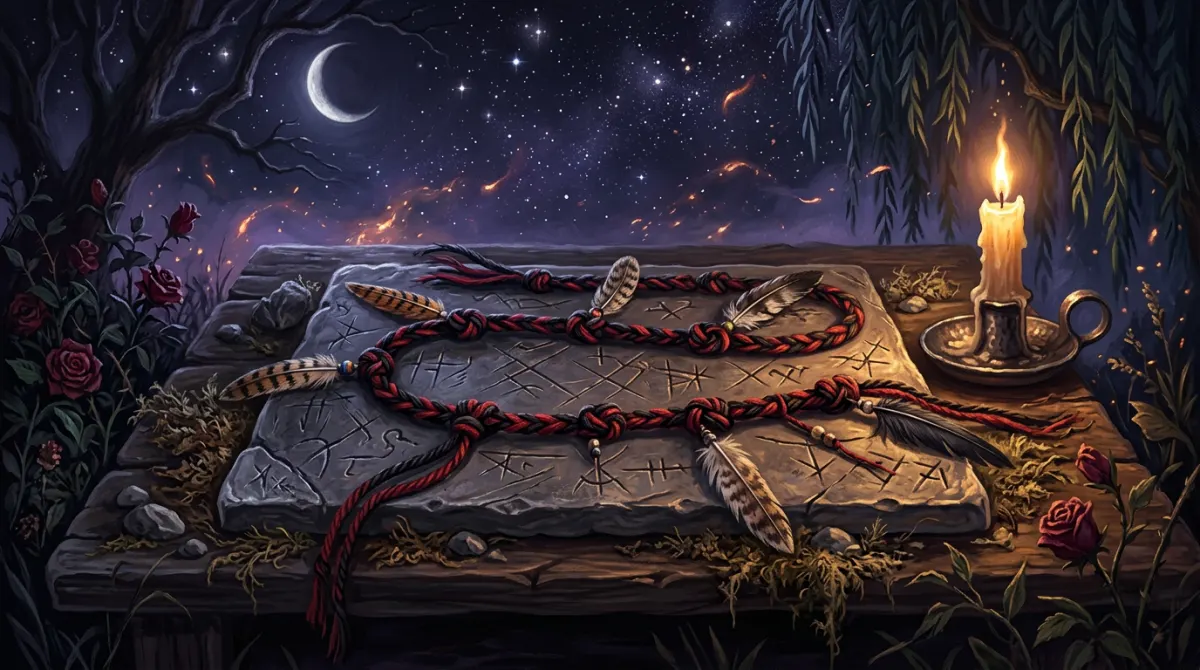
Wrap the ribbon three times around the middle, saying you bind this strength to yourself.
Keep the poppet in a drawer or by the bed. On hard days, hold it for a minute and breathe.
When the season has passed, unwrap the ribbon, thank it, and bury the poppet or keep it as a memento. Never make one for another person without their full knowledge and consent.
Take care: Make poppets only of yourself or with a person's informed consent; never to harm, compel or control anyone. Keep pins out of the figure and away from children.
Versions across time and place
i
The Louvre bound figurine
Roman Egypt · 3rd to 4th century AD
A small unfired clay woman, kneeling with her arms bound behind her and pierced by thirteen pins, was found in a clay pot with a lead tablet. The tablet asks spirits of the dead to bring her to the man who commissioned it. The set closely matches a recipe in the Greek magical papyri in Paris (PGM IV), showing that sorcerers worked from handbooks.
Uses: Clay figure, 13 bronze pins, Lead tablet, Pot
Recorded in: Musée du Louvre, E 27145; Robert K. Ritner, 'Anubis, Archer Figures, and Demotic Magic'
ii
Wax kolossoi in a Greek oath
Ancient Greek civic ritual · 7th to 4th century BC
The founders of Cyrene, according to an oath inscription set up in the 4th century BC, molded wax figures and burned them while swearing that anyone who broke the oath should melt away like the wax. Here the image bound a whole community to its promise rather than harming a named enemy.
Recorded in: Christopher A. Faraone, 'Binding and Burying the Forces of Evil', Classical Antiquity 10 (1991)
iii
The Pendle clay pictures
Lancashire, England · 1612
At the Pendle trials of 1612, Elizabeth Southerns (Old Demdike) was said to have confessed that she made clay pictures of her victims, dried them and pricked them where she wished illness. Witnesses including the child Jennet Device spoke of clay images at Malkin Tower. Ten people were hanged at Lancaster, and Potts's account became the best-known English witch-trial record.
Recorded in: Thomas Potts, The Wonderfull Discoverie of Witches in the Countie of Lancaster (1613)
History
Image magic rests on the idea that a likeness shares in the thing it shows. Egyptian priests broke and burned clay figures of enemies; Greek cities melted wax figures to seal oaths; Roman Egypt produced the bound and pierced figurine now in the Louvre, which follows a recipe from the Greek magical papyri. The figures are among the most direct survivals of ancient magic, because the objects themselves were buried and found again.
In early modern England, 'pictures' of wax or clay were standard evidence in witch trials, from the Pendle case of 1612 onward, and stuck figures turn up in house walls and chimneys. The cloth poppet sold today grew from 20th-century witchcraft revival, where it is used mostly for healing or self-work. This catalog keeps the dark history and offers only a self-focused version.