Menu
☎ (951) 904-2477
Binding & Release

The Witch's Ladder and Knot Magic

Also called Witches' ladder, Wind knots, Knot spell, Cord magic

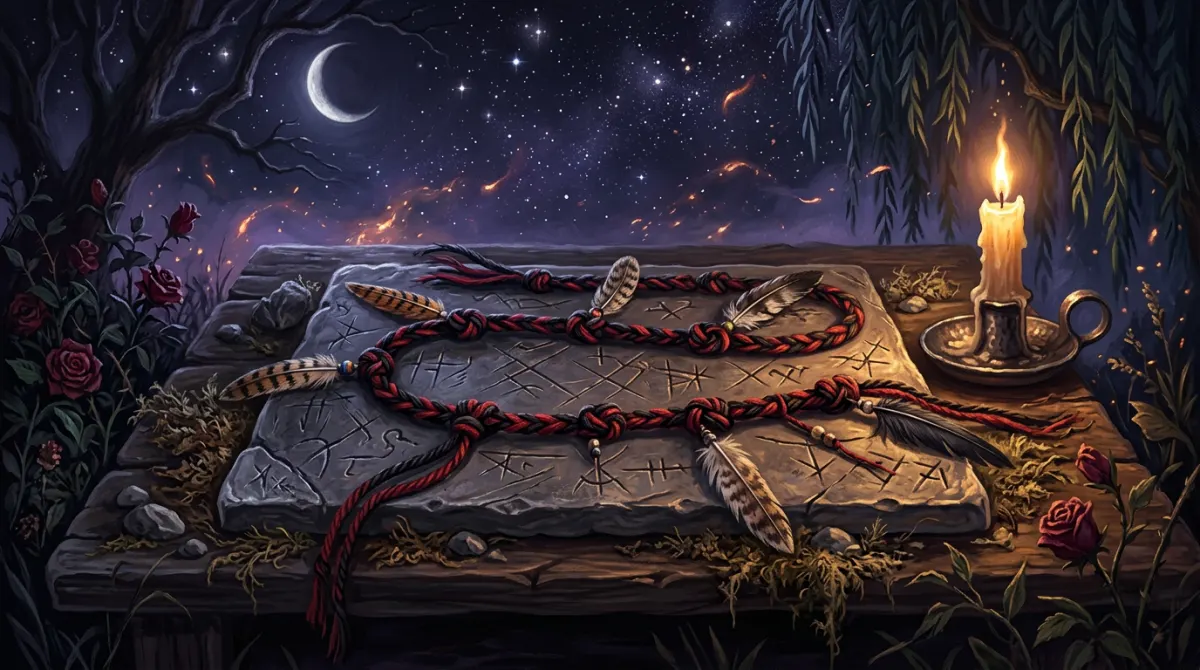
Tying a wish, a wind or a power into knots is one of the oldest binding methods. This version follows the feathered cord found in a Somerset attic and made famous in 1887, used here to bind a goal into nine knots.

TraditionEnglish folk magic and folklore
RegionSomerset, England
EraLate 19th century
Moon☽ Waxing moon
DayAny
ElementAir
Difficulty●○○ Simple
Time20 minutes

Tonight's moon is read when the page loads.

The working

  1. Decide on one goal, said in a single sentence, such as finishing a project or keeping a promise.
  2. Tie a loop at one end of the cord to hang it by.
  3. Tie the first knot near the loop and slip a feather into it, saying the goal aloud.
  4. Work down the cord, tying eight more knots with a feather in each, and repeat the goal with every knot. A common modern rhyme counts the knots: by knot of one the spell's begun, up to by knot of nine the thing is mine.
  5. Hang the finished ladder somewhere high and out of the way, as the Wellington cord was found in a roof space.
  6. When the goal is met, untie the knots one by one and thank whatever helped, then bury or compost the feathers and cord.

Take care: Use found or ethically sourced feathers only; in the US many wild bird feathers are protected by the Migratory Bird Treaty Act. Keep cords away from small children and pets.

Versions across time and place

i

The Wellington witches' ladder

Somerset, England · Found c. 1878; published 1887

Workmen demolishing an old house in Wellington, Somerset, found a long cord with cock feathers knotted along it, alongside brooms and a chair. They called it a witches' ladder. Dr Abraham Colles published it in The Folk-Lore Journal in 1887, and E. B. Tylor showed it at the British Association. Anna Tylor gave it to the Pitt Rivers Museum in Oxford in 1911.

Uses: Cord, Cock feathers

Recorded in: Abraham Colles, 'A Witches' Ladder', The Folk-Lore Journal 5 (1887); Pitt Rivers Museum object 1911.32.7
ii

Wind sold in three knots

Finnish and Sámi coasts, as described by Olaus Magnus · 1555

The Swedish churchman Olaus Magnus described wizards of the far north who sold sailors a rope with three knots. Untying the first brought a gentle wind, the second a strong one, and the third a storm. His woodcut shows a ship sinking in the background because its crew untied the third knot.

Uses: Rope with three knots

Recorded in: Olaus Magnus, Historia de gentibus septentrionalibus (Rome, 1555), Book 3
iii

Those who blow on knots

Islamic scripture and protective practice · 7th century to present

The second-to-last chapter of the Qur'an asks refuge from the evil of those who blow on knots, a reference to Arabian knot-sorcery. Muslims recite al-Falaq and al-Nas as protection against magic. This version runs the other way: it is a shield against knot magic, not a use of it.

Recorded in: Qur'an, Surah al-Falaq (113)

History

Knots appear in magic almost everywhere because a knot does what a binding spell wants: it holds something fast until someone chooses to loose it. Ancient Babylonian incantations untie knots to free the sick, the Qur'an warns against those who blow on knots, and Olaus Magnus in 1555 wrote of northern wizards selling winds tied in rope. Midwives in many parts of Europe untied every knot in a house to ease a birth.

The Wellington cord made the 'witches' ladder' famous. The Pitt Rivers Museum notes that the workmen's witchcraft explanation rested on hearsay; E. B. Tylor never found proof of magical use, James Frazer guessed it stole milk from neighbors' cows, and others suggested a hunting or bird-scaring line. The idea took hold anyway, and modern witches adopted the knotted, feathered cord as a way to bind their own intentions.

Sources

  1. Englishness: The Witch's Ladder · Pitt Rivers Museum, University of Oxford
  2. A Case Re-opened: The Science and Folklore of a 'Witch's Ladder' · University of East Anglia research portal
  3. Historia de gentibus septentrionalibus · Olaus Magnus, 1555

Related spells

Want one made just for you?

Tell us what you need and we will craft a custom spell, charm or reading for it. Or call to book a reading or a road blessing in person.

☎ Call UsTranslate