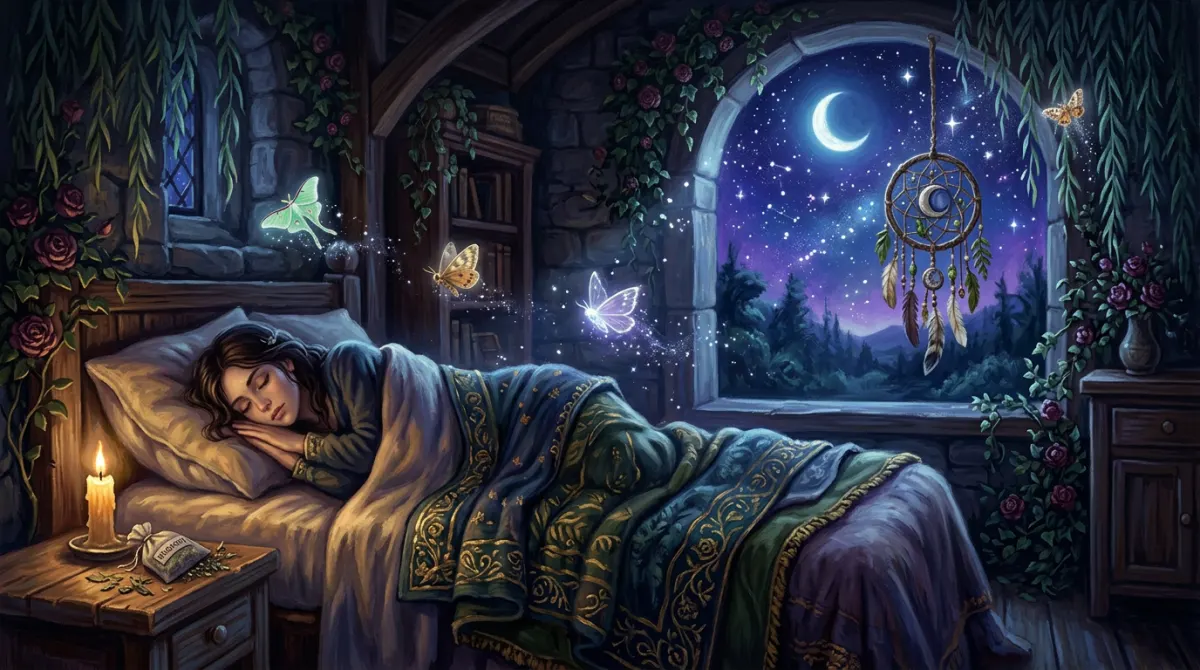
Also called Asabikeshiinh, Spider web charm, Bwaajige ngwaagan
An Ojibwe protective charm, a small hoop netted like a spider web and hung on a baby's cradleboard to catch harm. Later widely adopted as a dream charm. This entry explains its history and gives a respectful way to keep one.
TraditionOjibwe (Anishinaabe)
RegionGreat Lakes, United States and Canada
EraDocumented early 20th century, older in origin
Moon◐ Any moon
DayAny
ElementAir
Difficulty●○○ Simple
Time15 minutes
Tonight's moon is read when the page loads.
The working
Learn the story before you hang it: read Ojibwe sources on Asibikaashi, the Spider Woman, who watches over children.
Buy from a Native maker rather than a mass-produced copy, and ask the maker about the meaning of the design if they are willing to share.
Hang it above the bed or crib where morning light reaches it.
Treat it as a keepsake of protection, not decoration; avoid hanging it from car mirrors or wearing it as jewellery.
If it becomes damaged, retire it respectfully rather than throwing it in the trash; many Ojibwe teachers suggest returning natural materials to the earth.
Take care: Hang it out of a baby's reach and never inside a crib, since cords and small beads are strangling and choking hazards. This is a living cultural object: buy from Native makers and avoid fake Native-made labels, which are illegal under the US Indian Arts and Crafts Act.
Versions across time and place
i
Cradleboard spider webs
Ojibwe, Minnesota · Early 1900s
Densmore described two small netted hoops, usually hung on the hoop of a child's cradleboard, said by her Ojibwe informants to catch harmful things in the air as a spider's web catches what touches it. They were made from nettle fibre dyed red with bloodroot or plum bark, and by her time often of red yarn.
Uses: willow hoop, nettle fibre or red yarn
Recorded in: Frances Densmore, Chippewa Customs (1929)
ii
Pawnee netted hoop
Pawnee · Early 20th century
Densmore mentioned a similar netted hoop among the Pawnee that represented Spider Woman, a spirit linked to the buffalo. It shows the spider web image had meaning in more than one nation's tradition.
Uses: netted hoop
Recorded in: Noted by Frances Densmore in Chippewa Customs (1929)
iii
Pan-Indian dreamcatcher
Intertribal, 1960s to 1980s · 1960s to present
During the Pan-Indian movement of the 1960s and 1970s, other nations took up the dreamcatcher as a symbol of shared identity, and by the 1980s it was mass-marketed as a Native craft. Feathers and beads, and the idea that it filters bad dreams, became standard in this period. Many Ojibwe people have mixed feelings about the commercial version.
Uses: feathers, beads, sinew
Recorded in: Cath Oberholtzer, Dream Catchers: Legend, Lore and Artifacts (2012)
History
The Ojibwe name for the charm is often given as asabikeshiinh, a word for spider, or as the spider web charm. Ojibwe stories tell of Asibikaashi, the Spider Woman, who cared for the people and their children; as the nation spread across the Great Lakes, mothers and grandmothers wove webs on willow hoops to protect infants for her. Frances Densmore, who studied Ojibwe life in Minnesota, published the first detailed written description in Chippewa Customs in 1929.
The charm became famous far beyond the Ojibwe from the 1960s, when it spread through the Pan-Indian movement and then, in the 1980s, into gift shops worldwide. Much of what is sold is made overseas with no Native involvement. Buying from Ojibwe and other Native artists keeps the object tied to the people whose tradition it is. Ojibwe artists today still make and teach the craft in their own communities.
Sources
Chippewa Customs · Frances Densmore, 1929
Dream Catchers: Legend, Lore and Artifacts · Cath Oberholtzer, 2012