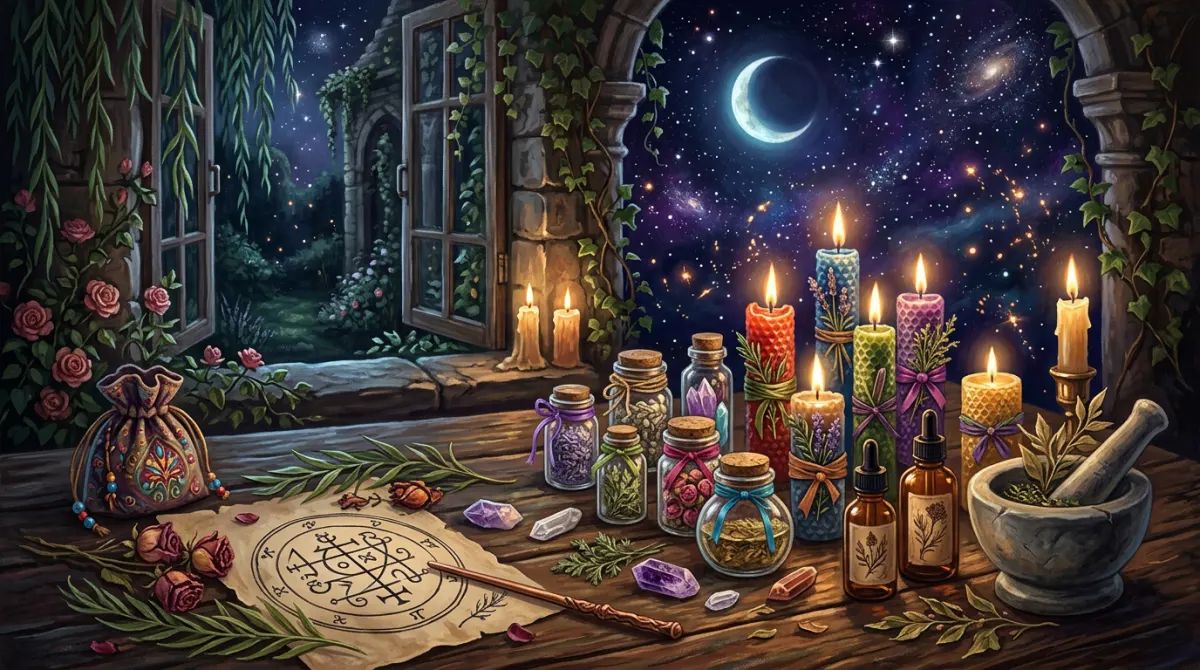
An altar is a small dedicated surface holding candles, symbols of the elements and objects meaningful to you, used as the focus for prayer and spellwork. This guide covers the Wiccan layout and simple personal altars, and where the greeting 'blessed be' comes from.
TraditionModern Wicca and personal folk practice
RegionBritain and the United States
Era1950s onward for the Wiccan form
Moon◐ Any moon
DayAny
ElementSpirit
Difficulty●○○ Simple
Time30 minutes
Tonight's moon is read when the page loads.
The working
Choose a spot that will not be bumped, away from curtains, with room to sit or stand in front of it.
Clean the surface, then lay the cloth. Many people bless the space with a little salt water or incense as they do this.
Place the element symbols. A common Wiccan arrangement puts earth to the north, air to the east, fire to the south and water to the west.
Set two candles at the back. In Wicca the left side is often for the Goddess (with a cup or bowl) and the right for the God (with a wand or knife).
Leave the centre clear as a working space for candles, a pentacle, or whatever spell you are doing.
Add your personal objects and seasonal touches: flowers in spring, grain at harvest, evergreens in winter.
Light the candles, say a short dedication, and close with 'blessed be' if you follow Wiccan custom. Keep the altar dusted and refreshed.
Take care: Keep candles well clear of cloths, dried flowers and shelves above, and never leave them burning unattended. Choose incense with good ventilation, especially around pets and children.
Versions across time and place
i
Ancestor altar
Many cultures, including Chinese, Mexican and African diaspora practice · Ancient to modern
Photos of the dead, their favourite foods and drink, water and a candle are kept for honouring family. The focus is remembrance and relationship, not spells.
Recorded in: See the related ancestor altar and Day of the Dead entries
ii
Hoodoo working altar
African American Hoodoo · 20th century
A worker's altar holds a Bible, saint images, oils and a fireproof surface for dressed candles. It is a workbench as much as a shrine, cleaned between jobs.
Recorded in: catherine yronwode, How to Practice Hoodoo Candle Magic (Lucky Mojo)
iii
Minimal travel or shelf altar
Modern eclectic witchcraft · 21st century
A tin, a box lid or a windowsill holding a tea light, a stone and a small image. It suits renters and shared homes.
Recorded in: Common modern practice
History
The Wiccan altar takes shape in the coven practice of Gerald Gardner (1884 to 1964), whose Witchcraft Today (1954) and The Meaning of Witchcraft (1959) introduced the religion to the public. Gardner drew on ceremonial magic, Freemasonry and folklore. The tools on a Wiccan altar, such as the athame, wand, chalice and pentacle, echo the four suits of the tarot and the instruments of ritual magicians. Later authors like Scott Cunningham and Raymond Buckland popularised solitary altars for people without a coven.
The greeting 'blessed be' comes from the same Gardnerian texts. In the Fivefold Kiss, used in the rite of Drawing Down the Moon and initiations, the priest blesses the feet, knees, womb, breast and lips, each line beginning 'Blessed be'. Over time the phrase became a general Wiccan greeting, farewell and sign-off, now used across pagan communities far outside Gardner's lineage.