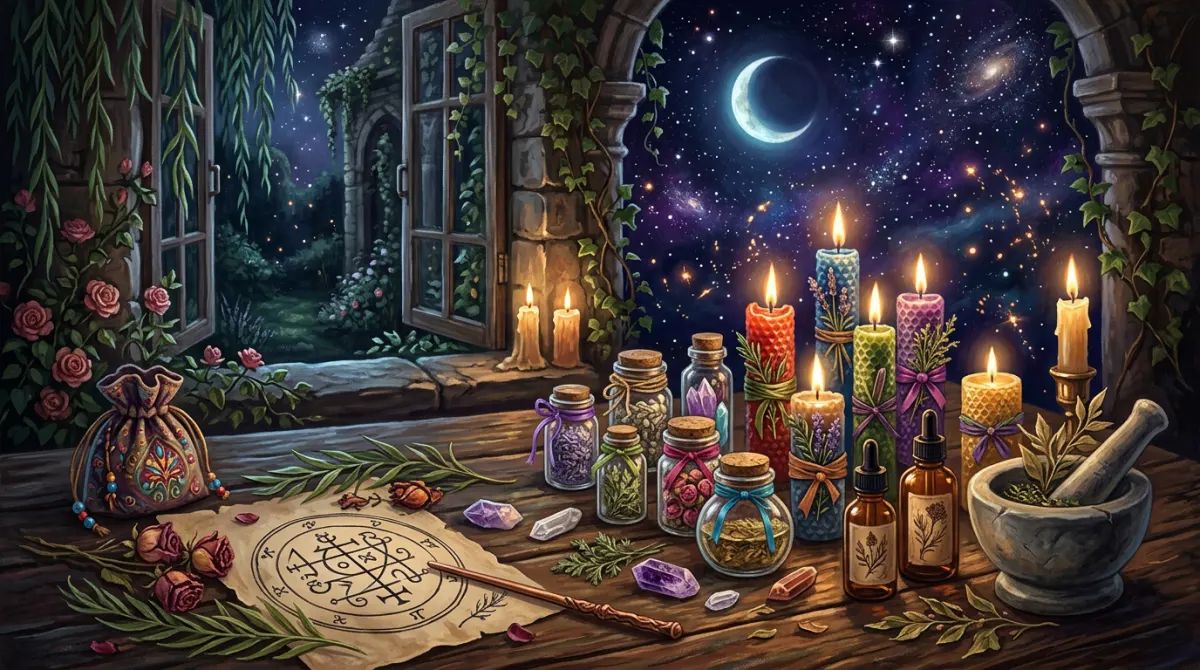
A sigil is a personal symbol made by reducing a written wish to an abstract design, charging it with focused attention, and then deliberately forgetting it. The method comes from the English artist Austin Osman Spare and became central to chaos magic.
TraditionAustin Osman Spare and chaos magic
RegionEngland
Era1913 onward
Moon◐ Any moon
DayAny
ElementSpirit
Difficulty●○○ Simple
Time15 to 30 minutes
Tonight's moon is read when the page loads.
The working
Write your intention as one short positive sentence in the present tense, for example 'I sleep deeply.'
Cross out every repeated letter so each letter appears only once.
Combine the remaining letters into a single shape. Overlap, rotate and simplify them until the design no longer reads as words.
Redraw the final sigil cleanly in the centre of a fresh sheet.
Charge it: sit quietly, gaze at the sigil and let your mind settle on it alone until you feel focused, a state Spare called the moment of emptiness. A slow breath count works well.
Release it. Burn the paper safely in a bowl, tear it up, or put it away out of sight.
Stop thinking about the wish. In Spare's method, forgetting the sigil is part of the work, so the desire is not undone by worry.
Take care: If you burn the paper, use a metal or ceramic bowl away from anything flammable and keep water nearby.
Versions across time and place
i
Goetic seals
Early modern European grimoires · 17th century
This grimoire gives a fixed seal for each of seventy-two spirits, drawn on metal or parchment by the magician. The seals act as signatures to call a named spirit, not as personal designs built from a wish. Spare's method reversed the idea by making the symbol from your own desire.
Recorded in: The Lesser Key of Solomon (Ars Goetia), compiled in the mid-17th century
ii
Planetary kamea sigils
Renaissance learned magic · 1530s
Agrippa printed magic squares for each planet. A name is turned into numbers and traced as a line across the square, giving a sigil for an angel or spirit. Modern magicians still trace words this way as an alternative to the letter method.
Recorded in: Heinrich Cornelius Agrippa, Three Books of Occult Philosophy (1533)
iii
Chaos magic sigils
Chaos magic · 1978 onward
Carroll and Sherwin took Spare's method as a core technique and added pictorial and mantric sigils, where a wish becomes a picture or a chant. Grant Morrison's 'Pop Magic!' essay (2003) popularised sigils for a wider audience.
Recorded in: Peter J. Carroll, Liber Null (1978); Ray Sherwin, The Book of Results (1978)
History
Magical seals are old. Medieval and early modern grimoires such as the Lesser Key of Solomon gave each spirit its own seal, and Agrippa's 1533 Occult Philosophy showed how to trace names across planetary number squares. These symbols were tied to named beings. The modern habit of building a sigil from your own wish began with Austin Osman Spare (1886 to 1956), a London artist who self-published The Book of Pleasure (Self-Love) in 1913.
Spare's idea was that desire works best once it sinks out of conscious thought. He reduced a statement to its letters, combined them into a glyph, charged it in a state of focus he called vacuity, and then forgot it. He died before chaos magic began, but Peter J. Carroll and Ray Sherwin, who both published in 1978, made his technique central to their movement, and chaos magicians often call him its grandfather. Sigils are now one of the most widely used methods in modern magic.