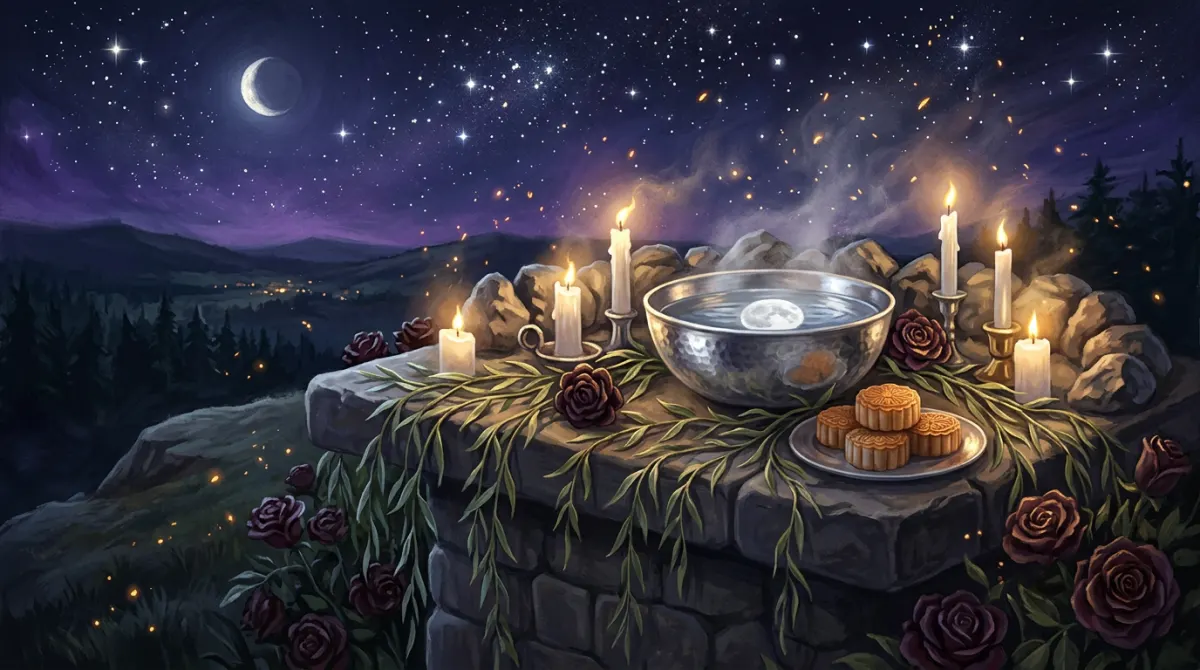
Also called April full moon, Egg Moon, Sprouting Grass Moon
The Pink Moon is the popular name for April's full moon, named for moss phlox, an early spring wildflower, and not for any pink color in the moon itself. Its rite is a flower blessing for tenderness and new growth.
TraditionNorth American almanac lore and modern seasonal practice
RegionNorth America (northern hemisphere)
Era1760s records; popularized 1930s onward
Moon○ Full moon
DayMoon
ElementAir
Difficulty●○○ Simple
Time30 to 45 minutes on the night of the full moon. It falls in April in the northern hemisphere; the next one is in April 2027.
Tonight's moon is read when the page loads.
The working
On the night of the April full moon, put the flowers in the glass of water near a window where the moonlight falls.
Light the candle and take a few slow breaths, noticing the scent of the flowers.
Write down one tender thing in your life that needs care to bloom: a friendship, a project, your own health.
Write one small, gentle action you will take for it this month.
Read it aloud to the moon, then fold the paper and tuck it under the glass.
Put out the candle, keep the flowers until they fade, then return them to the earth or compost and carry out your action.
Take care: Keep any candle on a fireproof dish and never leave it burning unattended. If you go outside at night, dress for the weather, take a light and tell someone where you are. Moon names tied to specific Native nations belong to living languages and ceremonies. Read them as those nations' own knowledge, not as rites to copy; the steps here are an open seasonal practice anyone can do.
Versions across time and place
i
Carver's Month of Plants
18th-century traveler's account · 1760s, published 1778
Carver called April the Month of Plants, the second month of a year that began in March. Pink Moon does not appear in his list at all; it came later through almanac use.
Recorded in: Jonathan Carver, Travels Through the Interior Parts of North America (1778)
ii
Egg Moon and the Easter moon
European and Christian calendar · medieval to 1937 print
The 1937 Maine Farmers' Almanac called the first spring moon the Egg Moon. In churches the first full moon on or after March 21 is the paschal moon, and Easter falls on the Sunday after it, so the April full moon is often the one that sets Easter's date.
Recorded in: Maine Farmers' Almanac (1937), as summarized in Wikipedia's Full moon article
iii
Boiling Sap Moon
Ojibwe (Anishinaabe) · living tradition
Ojibwe language resources give April names including Iskigamizige-giizis, the moon of boiling sap, and Loon Moon. They mark the maple sugar season and the return of birds to open water.
Recorded in: Ojibwe.net, Months / Moons
History
The Old Farmer's Almanac explains that the Pink Moon is named for moss pink, also called creeping phlox or moss phlox (Phlox subulata), a low groundcover native to the eastern and central United States that is among the first wildflowers to carpet the ground in spring. The moon itself is not pink. The name has spread widely in news and social media, and it is one of the names that grew more popular after Deanna Conway's 1995 book Moon Magick.
Older lists name April differently. Jonathan Carver's 1778 book called it the Month of Plants. The almanac also lists Breaking Ice Moon for the Algonquin, Moon When the Ducks Come Back for the Lakota and Frog Moon for the Cree. In the church calendar the April full moon often serves as the paschal moon that sets the date of Easter.