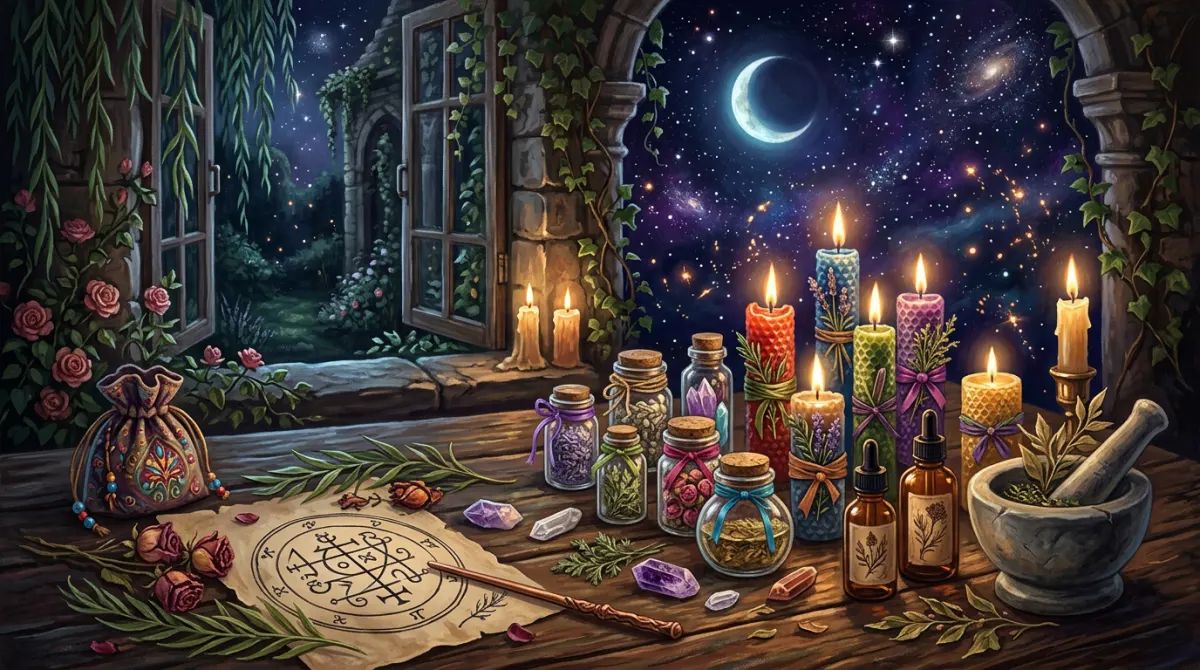
Also called spell jar, witch jar, sweetening jar, honey jar
A jar spell seals a written wish together with herbs, salt, sugar or other symbolic ingredients inside a closed container so the work keeps going for as long as the jar stays closed. It joins two old lines, the English witch bottle and the Hoodoo honey or sugar jar, with a modern craze for small decorative jars.
TraditionHoodoo sweetening jars and English concealed bottles, adapted by modern witchcraft
RegionUnited States and Britain
Era17th century bottles; 20th-century sugar jars; 2010s social media jars
Moon◐ Any moon
DayAny
ElementEarth
Difficulty●○○ Simple
Time20 minutes, then kept
Tonight's moon is read when the page loads.
The working
Choose one aim: sweetening a situation, protecting a home, or drawing money or luck.
Write your wish on the paper in plain words. Fold it toward you to draw something in, or away from you to send something off.
Put the folded paper in the jar and add the base: sugar or honey for kindness, salt for protection, rice or coins for growth.
Add the herbs one at a time, saying aloud what each is for.
Close the lid tightly. If you like, drip a little wax from a lit candle over the lid seam, holding the jar steady on a plate.
Keep the jar somewhere it will not be disturbed, such as an altar shelf for a sweetening jar or near the door for protection.
Renew it from time to time by holding it and repeating the wish, or by burning a short candle on a heatproof saucer beside it rather than on a plastic lid.
When the matter is settled, open the jar, thank it, and compost the plant material and bury or bin the rest.
Take care: Never burn a candle directly on a plastic lid or near a cork, and never leave it unattended. Do not add anything that can rot, such as fresh fruit or blood, to a sealed jar.
Versions across time and place
i
Hoodoo honey or sugar jar
African American Hoodoo · 1930s onward
A name paper is pushed into a jar of honey, sugar or syrup to make a person or situation kinder toward the worker, and candles are burned on the lid on set days. Hurston recorded a New Orleans worker keeping a sugar and honey jar for 'sweet' work. Sugar was used far more than honey until the internet era.
Recorded in: Zora Neale Hurston, Mules and Men (1935); catherine yronwode, Honey Jar and Sugar Bowl Spells (Lucky Mojo)
ii
English witch bottle
English counter-witchcraft · c. 1600 to 1750
Stoneware or glass bottles filled with bent pins, nails, hair and urine were buried under hearths and thresholds to trap harmful magic. It is the older protective cousin of the modern protection jar.
Recorded in: Brian Hoggard, Magical House Protection (2019)
iii
Social media spell jars
Online modern witchcraft · 2010s to 2020s
Tiny corked vials filled with layered salt, dried flowers and crystals and sealed with coloured wax became a popular craft in the 2010s and 2020s. These are newer and more decorative than the older jars, and their recipes vary from creator to creator.
Recorded in: Observed practice on Tumblr, Instagram and TikTok; no fixed published canon
History
Sealing magic inside a container is old. English householders buried witch bottles from the early 1600s, and archaeologists have found them in Britain and in colonial North America. In the American South a separate line developed. As packaged sugar reached grocery stores in the late nineteenth and early twentieth centuries, rootworkers used sugar boxes and jars to 'sweeten' bosses, judges and lovers, and Zora Neale Hurston described a New Orleans practitioner keeping such a jar in Mules and Men (1935).
The general phrase 'jar spell' is quite recent. Online witchcraft communities in the 2000s and 2010s widened the idea to any purpose, and catherine yronwode notes that honey only became the default sweetener around 2005, when online recipes spread. The decorative vial jars common on TikTok are a 2010s and 2020s craft. That is not a mark against them, but it is worth knowing which parts are old and which are new.