Also called August full moon, Ricing Moon, Corn Moon (some lists), Grain Moon
The Sturgeon Moon is the popular name for August's full moon, from the late-summer sturgeon fishing of the Great Lakes region that Jonathan Carver recorded. Its rite is a water and patience rite for long, slow goals, in honor of a fish that can live for many decades.
TraditionNorth American almanac lore and modern seasonal practice
RegionNorth America (northern hemisphere)
Era1760s records; popularized 1930s onward
Moon○ Full moon
DayMoon
ElementWater
Difficulty●○○ Simple
Time30 to 45 minutes on the night of the full moon. It falls in August in the northern hemisphere; the next one is in August 2027.
Tonight's moon is read when the page loads.
The working
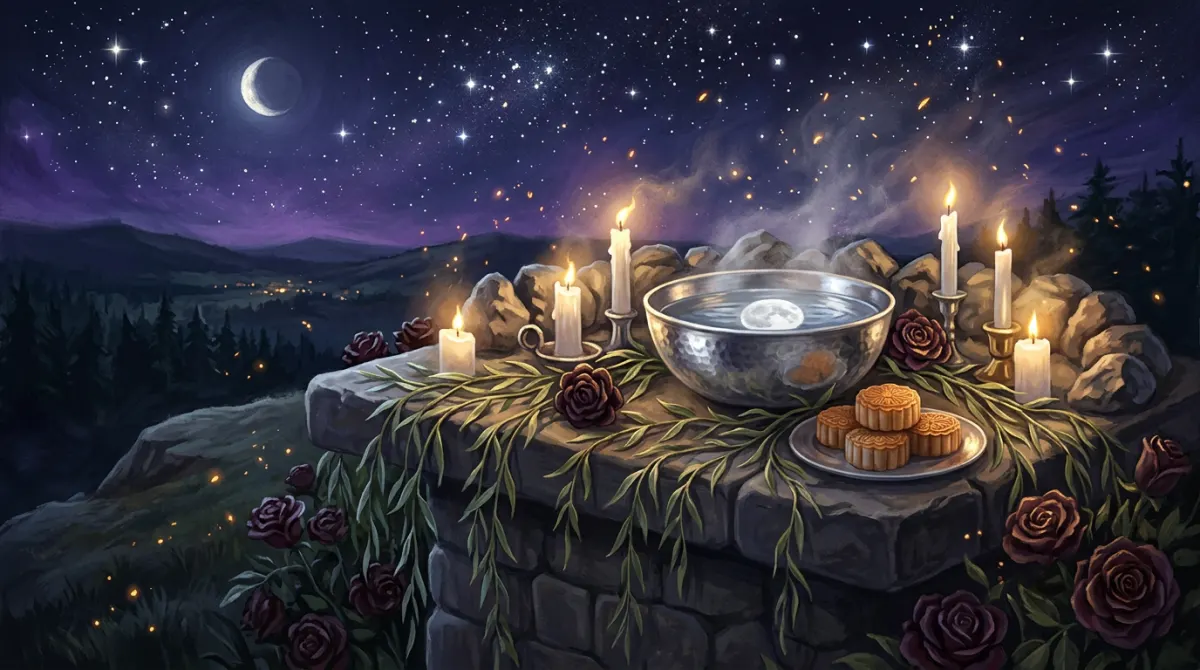
On the night of the August full moon, set the bowl of water where moonlight can reach it.
Hold the stone and think of something in your life that needs years rather than weeks: a skill, a savings goal, a long friendship, healing.
Write that goal and one patient habit that supports it.
Lower the stone into the water and say the habit aloud as a promise.
Leave the bowl in the moonlight while you sit for a few minutes listening to the evening.
Pour the water on a garden or tree in the morning, keep the stone on your desk, and if you can, give time or money to protect a local waterway.
Take care: Keep any candle on a fireproof dish and never leave it burning unattended. If you go outside at night, dress for the weather, take a light and tell someone where you are. Moon names tied to specific Native nations belong to living languages and ceremonies. Read them as those nations' own knowledge, not as rites to copy; the steps here are an open seasonal practice anyone can do.
Versions across time and place
i
Carver's Sturgeon Moon
18th-century traveler's account · 1760s, published 1778
Carver named August the Sturgeon Moon, the month when large numbers of sturgeon were caught. He recorded it while traveling the Great Lakes and upper Mississippi, where lake sturgeon were a key food.
Recorded in: Jonathan Carver, Travels Through the Interior Parts of North America (1778)
ii
Manoominike-giizis, Ricing Moon
Ojibwe (Anishinaabe) · living tradition
Ojibwe language resources give August as Manoominike-giizis, the Ricing Moon, for the wild rice harvest, along with berry names. Wild rice harvesting is a living practice with its own protocols and is not something to imitate as a ritual.
Recorded in: Ojibwe.net, Months / Moons
iii
Menominee sturgeon tradition
Menominee Nation · living tradition
The Menominee of Wisconsin have a Sturgeon Clan and hold a Sturgeon Festival, and regard the fish as a protector of wild rice. It is a community tradition to learn about and respect, not a rite for outsiders to copy.
Recorded in: Wikipedia, Lake sturgeon
History
Lake sturgeon are among the largest freshwater fish in North America, reaching about seven feet, and they live in the Great Lakes, Lake Champlain and the rivers around them. Validated ages reach 68 years, and females may not spawn until their teens or later. Jonathan Carver's 1778 list called August the Sturgeon Moon because so many were caught then, and the Old Farmer's Almanac repeats his name.
Commercial fishing in the late 1800s took millions of pounds of sturgeon a year, and the fishery collapsed around 1900 and never recovered. The species is now listed as endangered or threatened across much of its range, and restoration programs raise young fish for release. Other names for this moon in the almanac include Corn Moon for the Algonquin and Ojibwe and Flying Up Moon for the Cree.