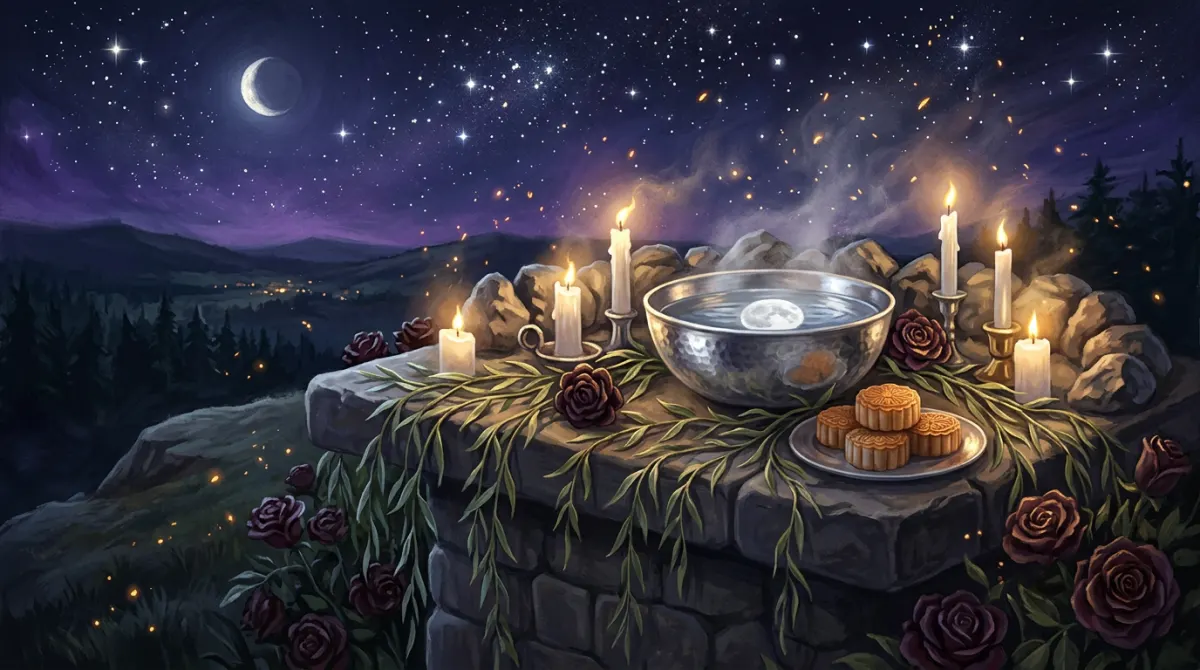
Also called November full moon, Frost Moon, Freezing Moon
The Beaver Moon is the popular name for November's full moon, recorded by Jonathan Carver for the season when beavers withdraw into their lodges with their winter food stored. Its rite is a home-sealing blessing: tighten up, warm up and settle in.
TraditionNorth American almanac lore and modern seasonal practice
RegionNorth America (northern hemisphere)
Era1760s records; popularized 1930s onward
Moon○ Full moon
DayMoon
ElementEarth
Difficulty●○○ Simple
Time30 to 45 minutes on the night of the full moon. It falls in November in the northern hemisphere; the next one is in November 2026.
Tonight's moon is read when the page loads.
The working
In the days before the November full moon, do the practical work: check doors and windows for drafts, set out blankets and stock the cupboard.
On the night of the full moon, tie the twigs into a small bundle like a beaver's lodge and set it by your front door.
Light the candle and walk through your home with it, pausing at each door and window to say what you want to keep in: warmth, peace, the people you love.
Touch a drop of salted water to each threshold as you go.
Return to the candle and name one thing you are storing for the months ahead, as the beaver stores branches under the ice.
Put out the candle and leave the bundle by the door until spring, then return it to the earth.
Take care: Keep any candle on a fireproof dish and never leave it burning unattended. If you go outside at night, dress for the weather, take a light and tell someone where you are. Moon names tied to specific Native nations belong to living languages and ceremonies. Read them as those nations' own knowledge, not as rites to copy; the steps here are an open seasonal practice anyone can do.
Versions across time and place
i
Carver's Beaver Moon
18th-century traveler's account · 1760s, published 1778
Carver named November the Beaver Moon, when beavers take shelter in their houses after laying up their winter food. The Old Farmer's Almanac cites him for the name.
Recorded in: Jonathan Carver, Travels Through the Interior Parts of North America (1778)
ii
Gashkadino-giizis, Freezing Over Moon
Ojibwe (Anishinaabe) · living tradition
Ojibwe language resources give November as Gashkadino-giizis, Freezing Over Moon, with related freezing names. It marks lakes and rivers icing over in the Great Lakes country.
Recorded in: Ojibwe.net, Months / Moons
iii
Frost Moon and Whitefish Moon
Cree, Assiniboine and Algonquin, as listed by the Old Farmer's Almanac · recorded 20th century
The almanac lists Frost Moon for the Cree and Assiniboine, and Whitefish Moon for the Algonquin, after the fall spawning of whitefish. Deer Rutting Moon appears for the Dakota and Lakota.
Recorded in: The Old Farmer's Almanac, Full Moon Names
History
Beavers spend late autumn cutting branches and sinking them into a food pile beside their lodge, then spend the ice-covered months mostly inside, swimming out under the ice to feed. Jonathan Carver's 1778 list named November for this, and the Old Farmer's Almanac repeats his Beaver Moon. The beaver was also the animal at the center of the North American fur trade, which is part of why European writers took note of its seasons.
In the almanac's collection the same moon has other names, including Frost Moon for the Cree and Assiniboine and Digging or Scratching Moon for the Tlingit, when bears dig their dens. The 1937 Maine Farmers' Almanac used English names for its fall moons, Harvest, Hunter's and Moon before Yule. Beaver Moon became the standard November headline through later almanacs and news coverage.