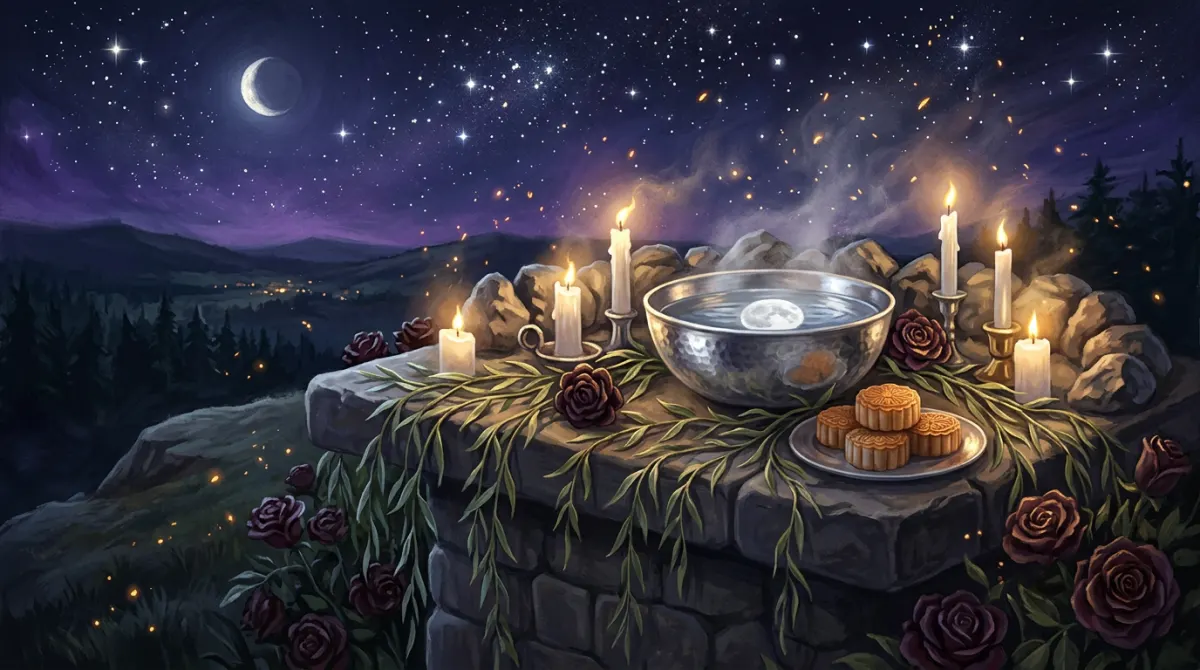
Also called full moon nearest the September equinox, Corn Moon, Barley Moon
The Harvest Moon is the full moon closest to the September equinox, so it usually falls in September and sometimes in early October. For a few nights around it the moon rises soon after sunset, giving farmers extra evening light, and its rite is a harvest gratitude meal.
TraditionEnglish rural lore and North American almanac usage
RegionBritain and North America (northern hemisphere)
Eraearly 18th century onward
Moon○ Full moon
DayMoon
ElementEarth
Difficulty●○○ Simple
Time1 to 2 hours, an evening meal. It usually falls in September, occasionally early October; the next one is in September 2027.
Tonight's moon is read when the page loads.
The working
Check when the full moon nearest the September equinox falls, and plan a simple meal for that evening.
Go outside around sunset to watch the moon rise in the east; near the Harvest Moon it comes up close to sundown.
Light the candle and set the seasonal food on the table.
Before eating, each person names one thing they harvested this year: work finished, lessons learned, money saved, food grown.
Fill the small plate with a bit of everything and set it aside for a neighbor, a food bank, or the birds.
Write down what you want to store for winter, such as rest, savings or skills, and keep the paper with your calendar.
Watch for the moon to rise again the next evening, only a short time later than the night before.
Take care: Keep any candle on a fireproof dish and never leave it burning unattended. If you go outside at night, dress for the weather, take a light and tell someone where you are. Moon names tied to specific Native nations belong to living languages and ceremonies. Read them as those nations' own knowledge, not as rites to copy; the steps here are an open seasonal practice anyone can do.
Versions across time and place
i
Carver's Corn Moon
18th-century traveler's account · 1760s, published 1778
Carver gave September as the Corn Moon, when corn is gathered. The Old Farmer's Almanac now uses Corn Moon for September in years when the Harvest Moon falls in October instead.
Recorded in: Jonathan Carver, Travels Through the Interior Parts of North America (1778)
ii
Mid-Autumn Festival
Chinese lunisolar calendar · Tang dynasty onward
China's Mid-Autumn Festival falls on the 15th day of the eighth lunar month, near the Harvest Moon. Families gather to admire the moon and share mooncakes; Korea's Chuseok and Japan's tsukimi are related harvest-moon observances.
Recorded in: Wikipedia, Full moon and Mid-Autumn Festival
iii
Shine On, Harvest Moon
American popular song · 1908
The vaudeville couple Nora Bayes and Jack Norworth introduced the song in the Ziegfeld Follies of 1908, and it became a standard. It fixed the Harvest Moon in American popular culture as a moon for courting and singing on a porch.
Recorded in: Wikipedia, Shine On, Harvest Moon
History
The Harvest Moon has a precise meaning: it is the full moon nearest the autumn equinox, around September 22 or 23, so it can fall up to two weeks on either side of that date. The Oxford English Dictionary cites the phrase from 1706. In most years the moon rises about 50 minutes later each night, but around this time NASA notes the gap shrinks to roughly 25 to 30 minutes across the northern United States, because the moon's path makes a shallow angle with the evening horizon.
That run of bright early evenings gave farmers extra light to bring in crops, which is the usual explanation for the name. The 1937 Maine Farmers' Almanac put Harvest first among its fall moons. The Harvest Moon is not unusually large or orange; it often looks that way because it is seen low near the horizon at moonrise, through more of the atmosphere.