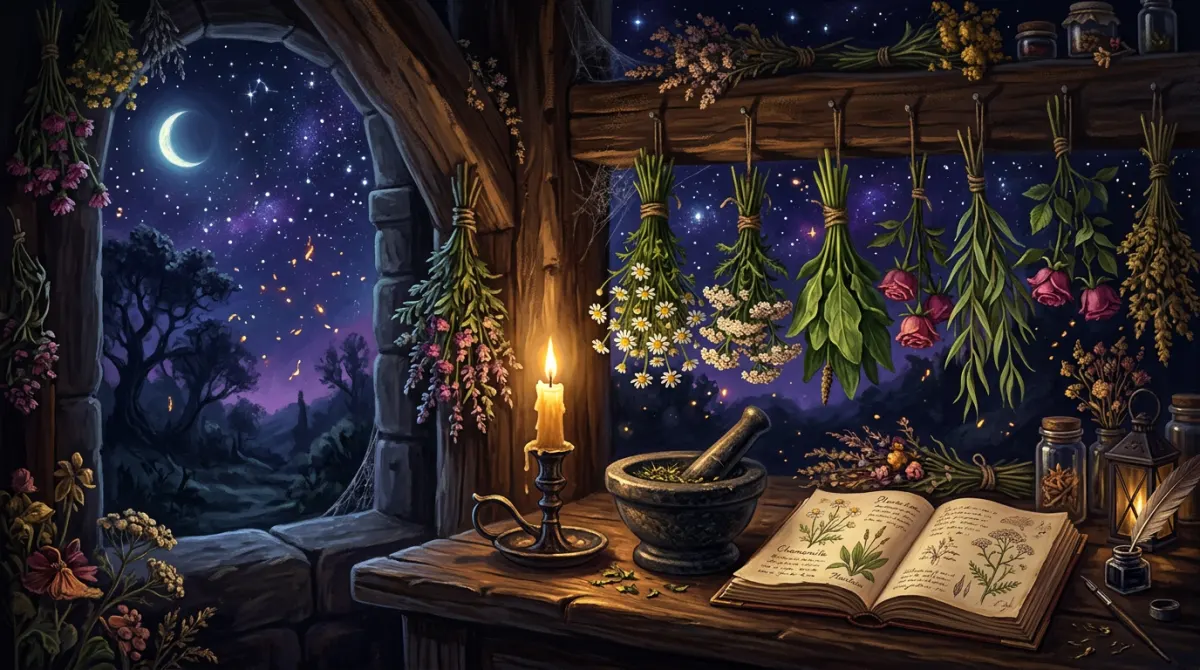
Also called Nigon Wyrta Galdor, Lacnunga herb charm
An Old English sung charm that names nine herbs and calls on their power against poison, infection and flying venom. It is folk tradition and history, not medical care: for any illness or wound, see a doctor.
TraditionAnglo-Saxon herbal charm
RegionEngland
Era10th century (recorded)
Moon◐ Any moon
DayAny
ElementEarth
Difficulty●●○ Moderate
Time1 hour to gather and arrange, 10 minutes to recite
Tonight's moon is read when the page loads.
The working
Read a modern translation of the Nine Herbs Charm through once so you know the order in which it names the herbs.
Lay the cloth out on a table and place the nine herbs on it in that same order, from mugwort to fennel.
Touch each herb as the poem names it and say aloud, in your own words, what the poem asks of it: strength against what harms the body.
When you reach the passage about Woden and the nine twigs, lay nine small sticks or stems across the cloth as a reminder of the poem's image of sickness broken into nine parts.
Finish by reciting the closing lines over the gathered herbs three times, as the old charms often repeat their words.
Bundle the herbs into the cloth and hang it to dry as a household keepsake. Do not eat them or make them into a salve for wounds.
If you or someone near you is unwell, treat the charm as a companion to medical care and call a doctor.
Take care: Folk tradition only, not medical treatment: see a doctor for any illness, wound or infection. Do not eat the herbs or put homemade herb pastes on open wounds; mugwort should be avoided entirely in pregnancy and nettles sting bare skin.
Versions across time and place
i
The Lacnunga salve
Late Anglo-Saxon monastic medicine · c. 1000
In the manuscript the poem is followed by prose directions: the herbs are pounded to dust and mixed with old soap and apple juice into a paste, with the charm sung over the herbs and into the patient. It sits among remedies that blend herb lore, Christian prayer and older Germanic ideas of disease as flying venom. Modern readers should not copy the paste.
Uses: the nine herbs, old soap, apple juice, ash and water in some readings
Recorded in: Lacnunga, British Library Harley MS 585; discussed in M. L. Cameron, Anglo-Saxon Medicine (1993)
ii
Woden and the nine glory-twigs
Pre-Christian Germanic belief preserved in a Christian manuscript · Recorded 10th century, older in origin
One stanza tells how Woden took nine glory-twigs and struck a serpent so that it flew into nine parts. It is one of only two clear mentions of Woden in Old English verse. Some scholars, including Henry Mayr-Harting, have suggested the twigs were marked with rune initials of the plants.
Uses: nine twigs
Recorded in: R. K. Gordon, Anglo-Saxon Poetry (1962), translation of the charm
iii
Gotland mugwort lore
Swedish folk belief · 19th century
The poem calls mugwort una, the oldest of herbs. Scholars have pointed to a Gotland folk saying recorded in 1875 in which mugwort asks to be called by a special name, as evidence that the habit of addressing this plant directly lasted in Scandinavian folk memory for centuries.
Uses: mugwort
Recorded in: Gotland folk item recorded 1875, noted in scholarship on the charm
History
The Nine Herbs Charm survives in a single manuscript, British Library Harley MS 585, inside the Old English medical collection that scholars call the Lacnunga, a Latin word for remedies. The collection was written down around the turn of the first millennium, probably in a monastery, and mixes Latin prayers, Old English verse charms and herbal recipes. The charm addresses each plant in turn as though it were a living helper and sets the herbs against venoms carried on the wind.
The poem is valued today because it preserves a pagan figure, Woden, inside a Christian book, and because it shows how Anglo-Saxon healers thought about disease as something that flew, stung or shot into the body. Historians such as M. L. Cameron argued that some Lacnunga remedies had sensible herbal logic, while the charm itself worked as prayer and performance. It has become one of the best known pieces of Old English verse outside Beowulf.