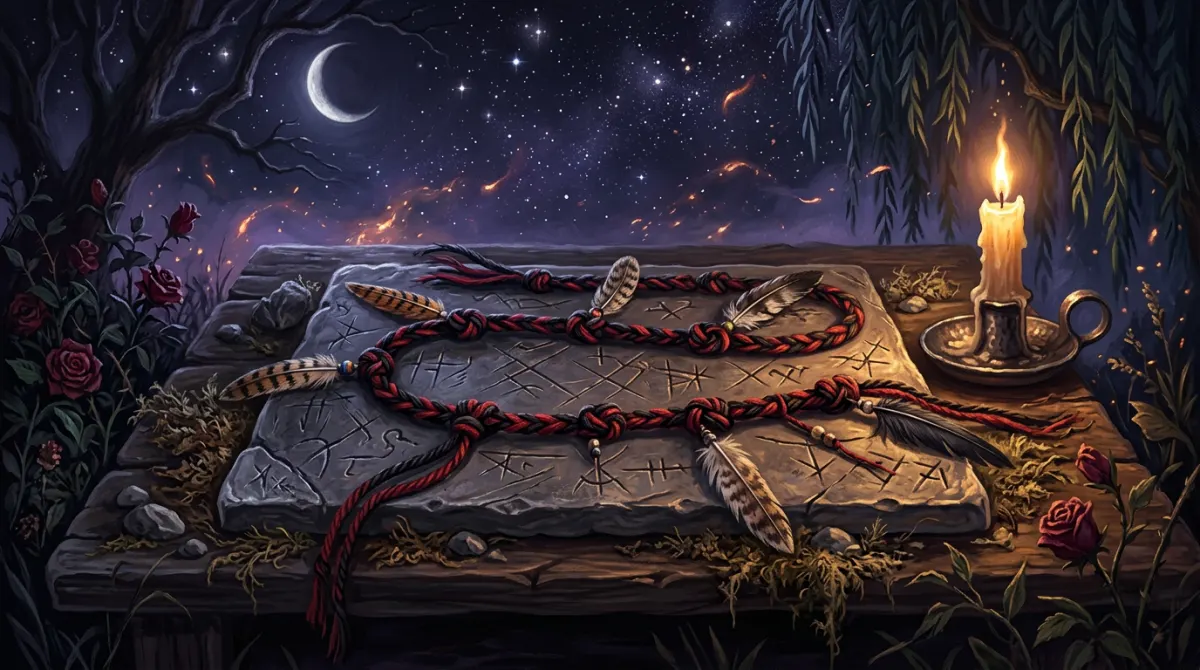
A spell that ties up a harmful force so it cannot act. Ancient bindings targeted rivals; the consent-safe modern version binds your own harmful actions or a destructive pattern, never another person.
TraditionGreco-Roman binding magic and modern Wicca
RegionMediterranean, Britain, United States
EraAncient to present
Moon☾ Waning moon
DaySaturday · Saturn
ElementEarth
Difficulty●●○ Moderate
Time20 minutes
Tonight's moon is read when the page loads.
The working
Name the pattern you want to bind in yourself, such as 'my sharp words when I am tired' or 'my spending when I am anxious'. Do not name anyone else.
Write it on the paper and wrap the paper around the stick or tube.
Light the candle if you are using one. Hold the wrapped stick and say why the pattern needs to stop and what it has cost you.
Tie the ribbon on and wind it around the stick, saying with each turn something like 'Bound from harm, bound from harm.'
Finish with three knots, one for thought, one for word and one for deed.
Keep the bound stick somewhere you will see it as a reminder, or bury it in a pot of soil.
When you feel the pattern has truly changed, untie it with thanks and recycle the paper.
Take care: Never name, picture or target a real person; this version binds your own behavior. Keep any candle on a stable holder and out of reach of children and pets. If someone is harming you, contact the police, a domestic violence line or a trusted adult instead of relying on a spell.
Versions across time and place
i
Greek and Roman defixiones
Ancient Mediterranean binding magic · 5th century BC to 5th century AD
Thin lead sheets were scratched with a rival's name, rolled, sometimes pierced with a nail, and dropped into wells, springs or graves to bind the tongue or limbs of a legal opponent, chariot racer or lover. Recorded here as history only; the safe modern adaptation binds a habit instead.
Uses: lead sheet, stylus, nail
Recorded in: Curse tablet scholarship; John G. Gager, Curse Tablets and Binding Spells from the Ancient World (1992)
ii
Binding by knots
European folk magic · Medieval to 19th century
Tying knots in cord while speaking was a widespread way to hold something fast, from wind knots sold to sailors to cords tied against illness. The modern habit binding above follows this pattern.
Uses: cord
Recorded in: European knot-magic folklore; see witches-ladder entry
iii
Binding harm in Wicca
Modern Wicca · Mid-20th century to present
Because the Wiccan Rede advises 'an it harm none', many Wiccans refuse to bind people at all, or bind only the harmful act, asking that someone be prevented from hurting others without naming any further fate. Others hold that even this overrides free will. The self-binding above avoids the problem entirely.
Recorded in: Wiccan Rede, first recorded in a 1964 speech by Doreen Valiente
History
Binding is one of the oldest kinds of recorded magic. Archaeologists have found more than a thousand Greek and Latin curse tablets, called katadesmoi and defixiones, which asked gods or the dead to bind an enemy's tongue, hands or luck. Large caches turned up at the sacred spring in Bath, England, where Roman Britons cursed thieves who had stolen cloaks and coins. The scholar John Gager collected many of them in translation in 1992.
In modern witchcraft binding raises a question of ethics. Doreen Valiente gave the first recorded wording of the Wiccan Rede in a 1964 speech, advising that a witch may do as she will if it harms none. Ever since, witches have argued over whether binding another person is ever acceptable. Many settle on binding harmful actions rather than people, and the gentlest practice of all binds one's own worst habits.