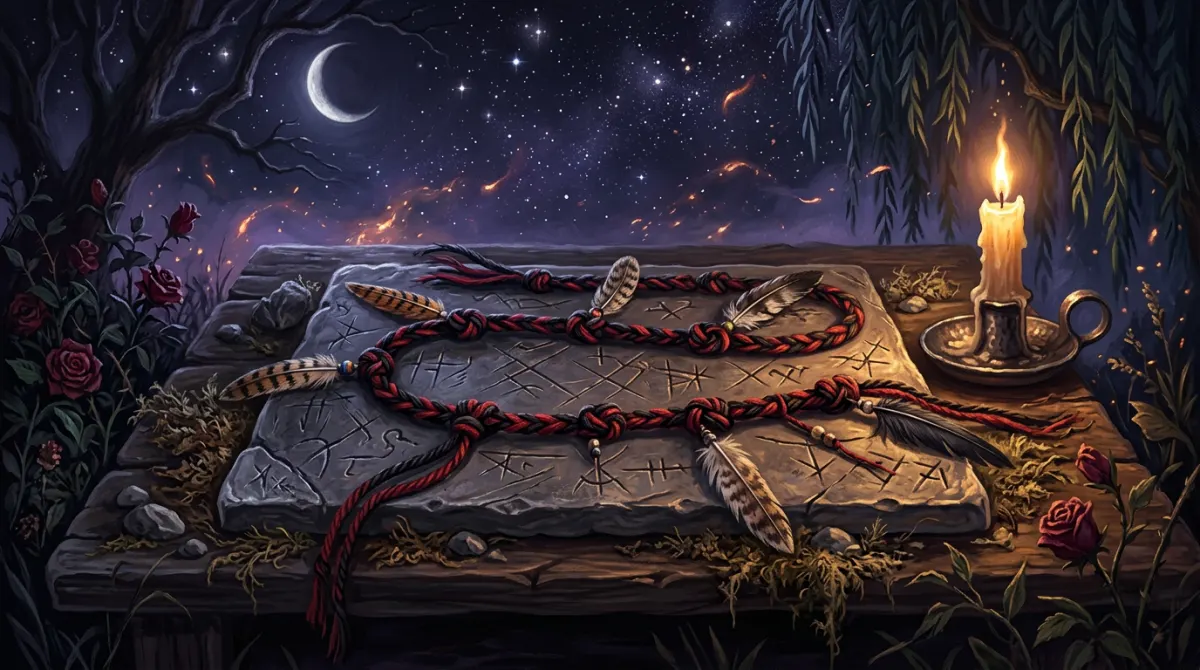
Also called cord cutting spell, cutting the ties that bind, energy cord cutting
A modern ritual for letting go of an old attachment: a string joining two candles stands for the tie, and you burn or cut it to mark that you are taking your own energy back. It is a release of your own feelings, not something done to another person.
TraditionModern energy healing and contemporary witchcraft
RegionUnited States and Britain
EraLate 20th century to present
Moon☾ Waning moon
DaySaturday · Saturn
ElementFire
Difficulty●○○ Simple
Time30 to 60 minutes
Tonight's moon is read when the page loads.
The working
Choose a quiet evening, ideally while the moon is waning, and set the plate on a clear, heat-proof surface away from curtains.
On the paper, write what you are releasing in terms of yourself, such as 'the hold this old relationship has on my thoughts' or 'my habit of checking their page'. Do not write anyone's name.
Stand the two candles a hand's width apart on the plate. One stands for you; the other stands for the attachment you described, not for a person.
Tie one end of the string around the base of each candle so it runs between them, and set your paper under the string.
Light both candles. Sit for a few minutes and name, out loud or in writing, what that tie gave you and what it costs you now.
Let the flames burn down to the string until it parts, or cut it with the scissors and say that you are taking your own attention and energy back.
Pinch or snuff out the candles once the string has parted. Never leave them burning unattended.
Throw the string and paper away outside your home, then do something that grounds you, like a shower, a walk or a meal.
Take care: Candle flame and burning string can drop hot wax and sparks, so use a fireproof plate, keep water nearby and never leave it unattended. This is a release of your own feelings: never name, picture or target a real person. If an attachment involves abuse or feels unmanageable, talk to a counselor; in the US you can call or text 988.
Versions across time and place
i
Krystal's figure-eight visualization
Phyllis Krystal's method · 1980s onward
The best-known written source for the idea. Krystal taught a guided visualization in which a person pictures a figure eight of light around themselves and the other party, then imagines the ties between them being cut, starting with people and moving on to habits and symbols. No candles or string are used.
Uses: a quiet room, guided visualization
Recorded in: Phyllis Krystal, Cutting the Ties That Bind (1982)
ii
Cords in the energy field
Energy healing · 1987
Brennan, a former NASA physicist turned healer, described relationship cords running between people's energy centers in her popular healing manual. Later energy workers turned this into hands-on or visualized cord releasing, usually done by a practitioner with the client present.
Recorded in: Barbara Ann Brennan, Hands of Light (1987)
iii
Candle and string release
Contemporary witchcraft · 2000s onward
The version given above, which turns the visualized cord into a literal piece of string between two candles. It works as sympathetic magic, the old idea that acting on a symbol acts on what it stands for. Some practitioners cut the string with scissors instead of letting it burn.
Uses: two candles, string, plate
Recorded in: Widely taught in modern witchcraft books and online; no single early source
History
Cord cutting has no medieval pedigree. The phrase and the method come mostly from the twentieth-century energy-healing world. Phyllis Krystal, a Californian therapist, published Cutting the Ties That Bind in 1982, teaching people to visualize and sever the ties that kept them tied to parents, partners, habits and fears. Barbara Ann Brennan's Hands of Light, published in 1987, gave many readers the image of cords of energy linking people's energy centers, which healers could clear.
Modern witches borrowed the idea and gave it a physical form, usually two candles joined by a thread that burns through. The method rests on sympathetic magic, a principle described by the anthropologist James Frazer in The Golden Bough, where a likeness stands in for the real thing. Today cord cutting is used after breakups, family estrangement or grief. Done well, it is about reclaiming your own attention, which is why it should never be aimed at a named person.