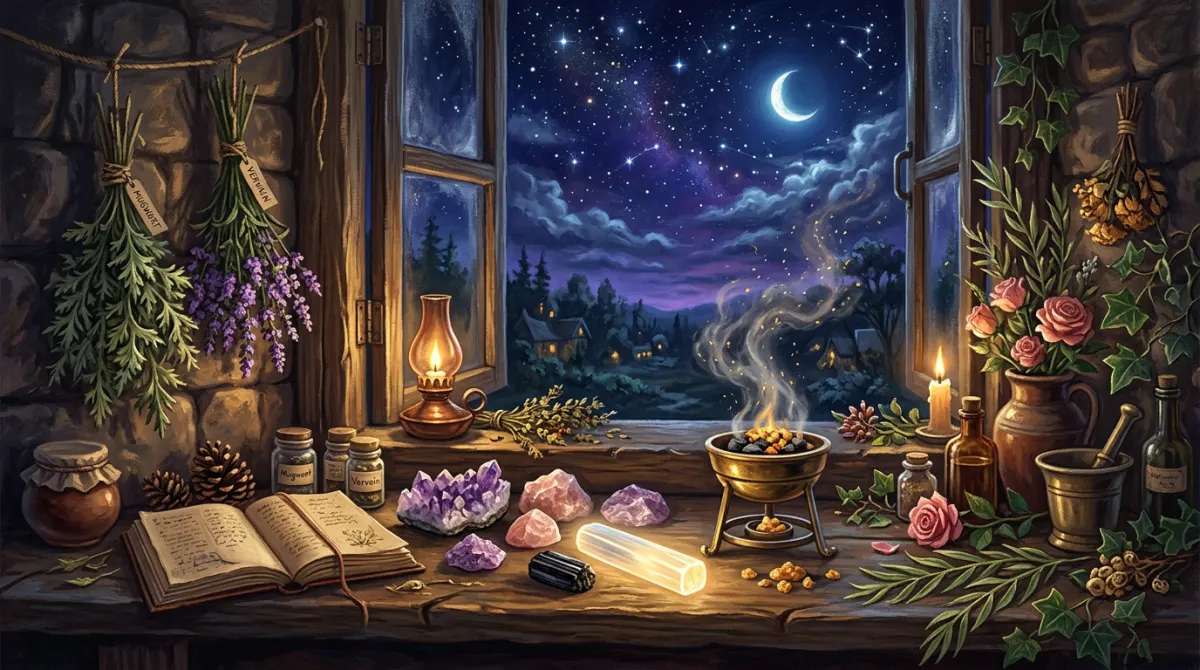
Myrrh is the bitter, warm, reddish-brown resin of Commiphora trees from the Horn of Africa and Arabia. Used in Egyptian embalming, Temple anointing oil and the gifts of the Magi, it is burned today for mourning, remembrance, deep prayer and protection, usually blended with frankincense.
TraditionAncient Egyptian, Israelite and Christian use, continued in modern folk incense
RegionSomalia, Ethiopia, Eritrea, Yemen, Oman
EraThird millennium BCE to present
Moon☾ Waning moon
DayMonday · Moon
ElementWater
Difficulty●○○ Simple
Time20 to 30 minutes
Tonight's moon is read when the page loads.
The working
Open a window, keep pets and birds out of the room, and set your sand-filled dish on a heat-proof surface.
Light the charcoal disc with tongs and let it ash over completely before adding anything.
If you have it, set a photo or the written name of someone you are remembering beside the dish.
Place one small piece of myrrh, or a pinch of your frankincense and myrrh blend, on the charcoal.
As the smoke rises, say what you are honoring or letting go of. Myrrh is traditionally the resin of grief, endings and patient healing.
Add a second piece only when the first has melted. Myrrh smoke is heavy, so less is better indoors.
Let the charcoal burn out in the dish or drown it in water, then air the room.
Take care: Burn myrrh only on incense charcoal in a fireproof dish with ventilation and never leave it unattended. Its smoke is heavy and can bother asthma, and pet birds should be kept well away. Do not swallow myrrh resin or oil, and avoid it in pregnancy unless a doctor approves.
Versions across time and place
i
Egyptian embalming
Ancient Egyptian mortuary practice · c. 5th century BCE account
Herodotus describes the most costly embalming as filling the cleaned body cavity with pure ground myrrh, cassia and other spices before natron drying. Myrrh's bitterness and resistance to decay made it a natural partner for preserving the dead.
Uses: myrrh, cassia, natron
Recorded in: Herodotus, Histories, Book II
ii
Holy anointing oil
Ancient Israelite worship · First millennium BCE
Moses is told to make a sacred oil with 500 shekels of liquid myrrh, cinnamon, fragrant cane and cassia in olive oil to anoint the Tabernacle and priests. Myrrh was also part of the Temple incense. Churches still use myrrh-scented chrism for anointing.
A hadith collected in later compilations advises fumigating houses with mugwort, myrrh and thyme. It reflects a long Middle Eastern habit of burning myrrh to freshen and protect the home rather than only in temples.
Uses: myrrh, mugwort, thyme
Recorded in: Kanz al-Ummal hadith collection, as cited in Wikipedia, Myrrh
History
Myrrh is the dried sap of thorny Commiphora trees, chiefly Commiphora myrrha, native to Somalia, Ethiopia, Eritrea, Yemen and Oman. The earliest Egyptian record of a trading voyage to Punt, under King Sahure of the Fifth Dynasty, lists myrrh among the goods brought home, and Hatshepsut's later expedition is painted on her temple at Deir el-Bahari. Egyptians burned it in temples and used it in embalming, perfumes and the sacred blend kyphi described by Plutarch.
In the Bible myrrh appears as a trade good in the Joseph story, as the base of the holy anointing oil in Exodus, and in the Song of Songs as a lover's perfume. The New Testament places it at both ends of Jesus' life: a gift of the Magi in Matthew 2:11, wine mixed with myrrh offered at the crucifixion in Mark 15:23, and a hundred-pound mixture of myrrh and aloes for his burial in John 19:39. That arc is why Christians tie myrrh to suffering and death.