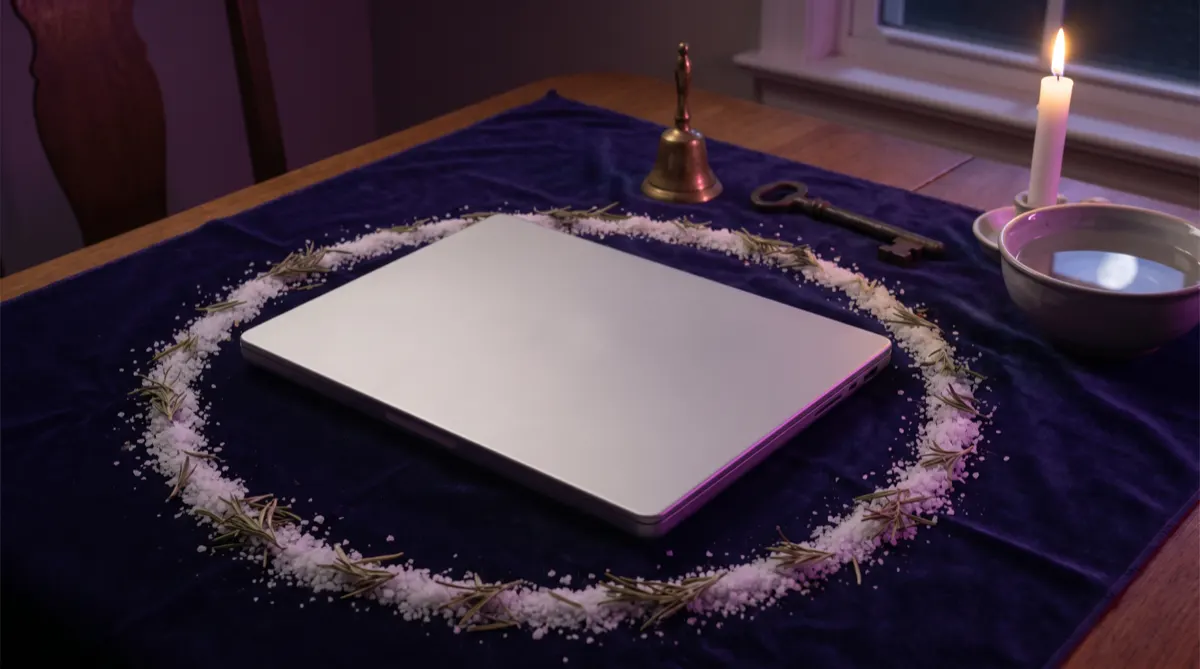
Bone to Bone: a Merseburg Repair Charm for Hardware
Also called Second Merseburg Charm, Wodan's horse charm, sprain charm, repair charm
The Second Merseburg Charm, a ninth or tenth century Old High German healing spell, closes with a famous list: bone to bone, blood to blood, limb to limb, as if they were glued. This page tells its history and adapts that joining formula as a charm said while repairing broken hardware.
TraditionOld High German healing charm
RegionGermany
Era9th or 10th century manuscript
Moon☽ Waxing moon
DayWednesday · Mercury
ElementEarth
Difficulty●●○ Moderate
TimeAs long as the repair takes
Tonight's moon is read when the page loads.
The working
Power the device off and unplug it. Take the battery out if it is removable, and ground yourself with an anti-static strap or by touching bare metal.
Write the joining words on a strip of paper and set it on the bench: bone to bone, wire to wire, joint to joint, as if they were glued.
Open the case slowly and lay the screws in the tray in the order they came out.
As you reseat each cable, connector or part, say the matching line quietly: connector to connector, pin to pin, board to board.
When the fault is fixed, close the case in reverse order and say the full joining line once more.
Power on and test. If it works, thank the old healers who said the words before you. If it does not, the charm has done its share; check the next most likely part.
Keep the paper strip with your repair log for the device.
Take care: Never open a device while it is plugged in. Swollen lithium batteries can catch fire: do not puncture or bend them, and take them to a battery recycler. Power supplies and old monitors hold dangerous charge; leave those to a qualified technician.
Versions across time and place
i
The original Second Merseburg Charm
Old High German · 9th or 10th century
Phol and Wodan ride into the woods and Balder's foal sprains its foot. Several goddesses sing charms over it, and then Wodan, who knew the craft best, sings bone to bone, blood to blood, limb to limb.
Recorded in: Merseburg Cathedral library manuscript; published by Jacob Grimm, 1842
ii
Scottish sprain charms
Scottish Gaelic folk healing · Collected 1860s to 1900
Carmichael recorded Gaelic sprain charms in which Christ or Saint Columba sets bone to bone and sinew to sinew, said while tying a black thread around the injured limb. They are clear descendants of the same joining formula.
Recorded in: Alexander Carmichael, Carmina Gadelica, Volume 2 (1900)
iii
Norwegian and Swedish horse charms
Scandinavian Christian folk charms · Medieval to 19th century
Later Nordic charms tell of Jesus riding to church when his horse stumbles, and he heals it with a list of joinings. The pagan gods are gone but the closing formula survives almost unchanged.
Recorded in: Merseburg charms, Wikipedia (summary of comparative studies)
History
In 1841 the historian Georg Waitz found two charms written into a blank page of a theological manuscript in the cathedral library at Merseburg, in Saxony. Jacob Grimm published them in 1842. They are the only known pre-Christian charms in Old High German. The second tells of Wodan healing a horse's sprained leg with a list of joinings, and versions of that list turn up in healing charms across Europe for the next thousand years.
The charm was made for horses and people. It never mentioned machines, and we do not claim it did. Our adaptation borrows only the shape of its closing line, a list that names each part and joins it to its partner, and says it while doing a careful repair. It works as a mindful repair habit that keeps you slow, orderly and attentive to every connector.