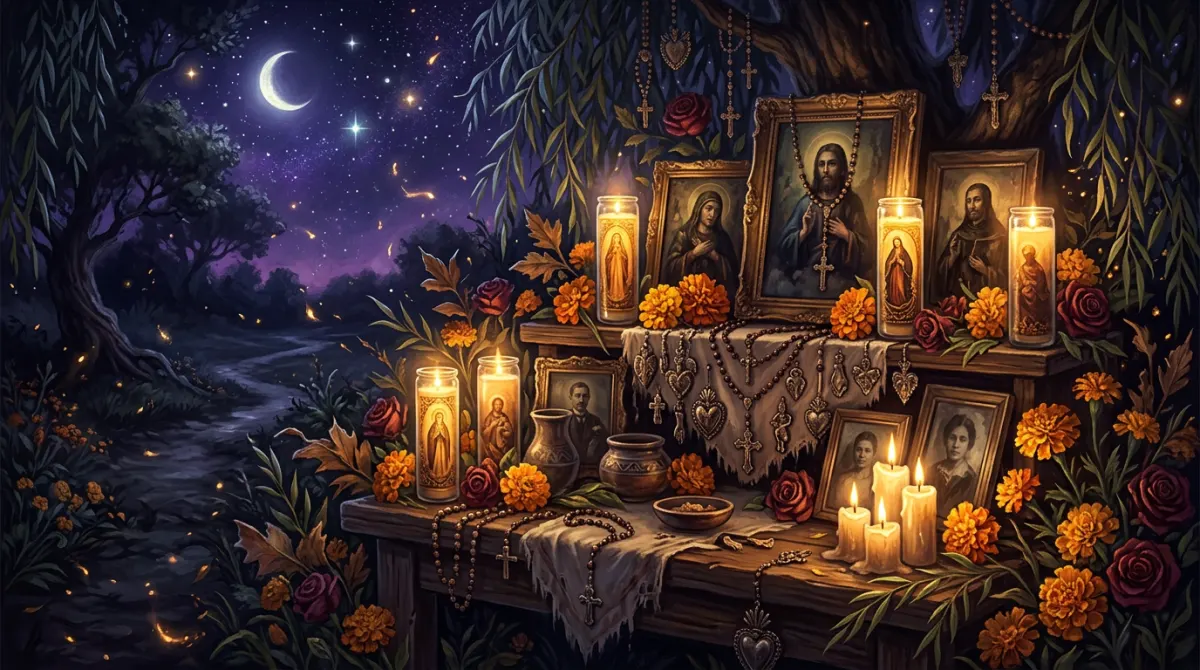
Also called milagritos, promesas, dijes, ex-voto, retablo, lámina
Milagros are small metal charms shaped like body parts, people, animals or objects, pinned to a saint's image to ask for healing or to give thanks; ex-voto paintings tell the story of a miracle in thanks for help received.
TraditionMexican and Iberian folk Catholicism
RegionMexico, US Southwest, Latin America, Spain, Portugal
EraAncient votive roots; colonial to present
Moon◐ Any moon
DayAny
ElementEarth
Difficulty●○○ Simple
Time15 minutes
Tonight's moon is read when the page loads.
The working
Choose a milagro whose shape names your request: a leg for a knee operation, an eye for sight, a house for a home, a praying figure for a person you are worried about.
Hold it and say your prayer, asking the saint for help or giving thanks for help already received.
Pin or tie the milagro to the saint's statue, cloth, or a board beside the image. Many churches have one; at home you can attach it to your own altar.
Leave it there as a lasting reminder of your prayer.
To make an ex-voto in thanks, paint a small picture of the danger or illness and the saint who helped, then write a few lines underneath: who, what happened, the date and your thanks.
Hang the painting near the saint's image, in a church that accepts them, or on your home altar.
Take care: Ask before attaching anything to a church statue; some parishes collect milagros in a box instead. Milagros are no substitute for medical care.
Versions across time and place
i
Tin retablos and ex-voto paintings
Mexican popular art · 19th and 20th centuries
Mexican ex-votos, also called retablos or láminas, were often painted on sheets of tin. They show the accident, illness or danger, the saint or Virgin floating above, and a written account below. Shrines such as San Juan de los Lagos hold thousands.
Recorded in: Wikipedia, Votive paintings of Mexico
ii
Migrant ex-votos
Mexican migrants to the United States · 20th century
Durand and Massey collected ex-votos from Mexican shrines that thank saints for safe border crossings, finding work or returning home. They read the paintings as first-person records of migration.
Recorded in: Jorge Durand and Douglas S. Massey, Miracles on the Border (1995)
iii
Milagros at New Mexico missions
Hispanic New Mexico · Present day
At the San Miguel Mission in Santa Fe, milagros are nailed to the old church bell, and many New Mexico churches have saint statues hung with ribbons of charms. Visitors still buy them from vendors near shrines.
Recorded in: Wikipedia, Milagro (votive)
History
Offering a model of the healed body part goes back to the ancient Mediterranean, where Greeks and Romans left clay feet, eyes and limbs at healing sanctuaries such as those of Asclepius. Iberian Christians kept the habit, and Spanish colonists brought it to the Americas. The word milagro means miracle, and the charms are made of silver, tin, brass, wax, wood or bone depending on the place and what the petitioner can afford.
Ex-voto, from Latin for from a vow made, names any offering given to fulfill a promise to a saint. In Mexico painted ex-votos on tin flourished in the 19th and early 20th centuries, made by local painters for ordinary families. Artists such as Frida Kahlo collected them, and today museums and scholars value them as a record of everyday life, illness, accidents and migration told in the words of the people who lived it.