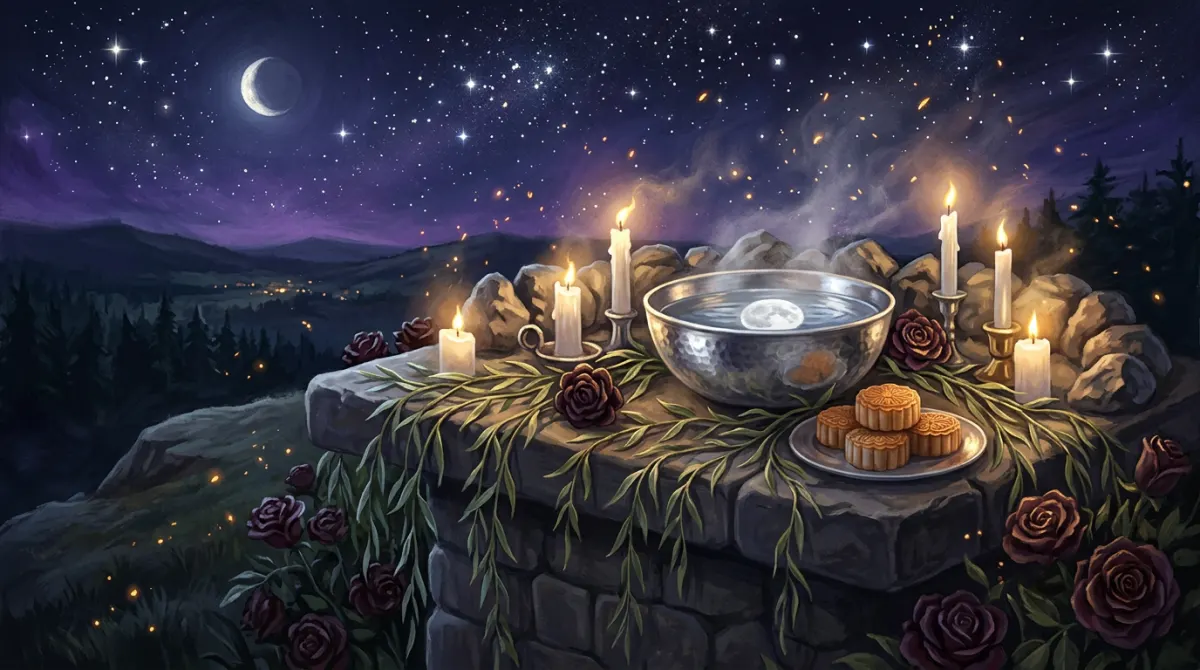
Also called January full moon, Moon after Yule, Cold Moon (Carver's January name)
The Wolf Moon is the popular name for January's full moon, the first full moon of the calendar year. The name was spread by American almanacs, and this page gives a quiet midwinter rite for the people you count as your pack.
TraditionNorth American almanac lore and modern seasonal practice
RegionNorth America (northern hemisphere)
Era1760s records; popularized 1930s onward
Moon○ Full moon
DayMoon
ElementWater
Difficulty●○○ Simple
Time30 to 45 minutes on the night of the full moon. It falls in January in the northern hemisphere; the next one is in January 2027.
Tonight's moon is read when the page loads.
The working
On the night of the January full moon, find the moon from a window or step outside for a few minutes and simply watch it rise.
Light the candle indoors and hold the warm drink while you settle.
Write the names of the people who make up your pack: family, friends, neighbors, the ones you would call in a hard winter.
Beside each name, write one thing you can do for them this month, however small.
Read the list aloud to the candle, then say a short thanks for warmth, food and company in the cold season.
Put out the candle and keep the list where you will see it, then reach out to at least one person on it within the week.
Take care: Keep any candle on a fireproof dish and never leave it burning unattended. If you go outside at night, dress for the weather, take a light and tell someone where you are. Moon names tied to specific Native nations belong to living languages and ceremonies. Read them as those nations' own knowledge, not as rites to copy; the steps here are an open seasonal practice anyone can do.
Versions across time and place
i
Carver's Cold Moon
18th-century traveler's account · 1760s, published 1778
Carver, who traveled the upper Mississippi in 1766 to 1768, listed the moon names he heard as a year starting in March. His January was the Cold Moon, the month of sharpest cold, not a wolf moon. His list is the oldest printed source behind several of the names now sold as a set.
Recorded in: Jonathan Carver, Travels Through the Interior Parts of North America (1778)
ii
Gichi-manidoo-giizis, Great Spirit Moon
Ojibwe (Anishinaabe) · living tradition
Ojibwe language resources give January names such as Gichi-manidoo-giizis (Great Spirit Moon) and Aabita-bibooni-giizis (Half Winter Moon), with wording that varies by community. These are part of a living language and ceremonial year and are shared here for understanding, not imitation.
Recorded in: Ojibwe.net, Months / Moons
iii
The almanac's winter moons
Maine Farmers' Almanac · 1937
The 1937 Maine Farmers' Almanac gave seasonal names it credited to English forebears, with the winter moons called Moon after Yule, Wolf Moon and Lenten Moon. That framing points to a European root for the wolf name rather than a Native one.
Recorded in: Maine Farmers' Almanac (1937), as summarized in Wikipedia's Full moon article
History
The Wolf Moon is now the most common name for January's full moon in American media, but its origin is murkier than most articles admit. The Old Farmer's Almanac says the name is probably English and came over with European settlers, and NASA notes that the Maine Farmers' Almanac began printing so-called Indian names for full moons in the 1930s. The wolf image itself is simple: wolves were heard more in the deep of winter, when packs travel and call to each other.
Older records tell a different story. Jonathan Carver's 1778 list calls January the Cold Moon, and the Old Farmer's Almanac's own alternates include Spirit Moon for the Ojibwe and Hard Moon for the Dakota. Historians note that 18th and 19th-century writers often flattened many nations' month names into one tidy list. The Wolf Moon is best read as almanac folklore, with real Native names standing apart from it.