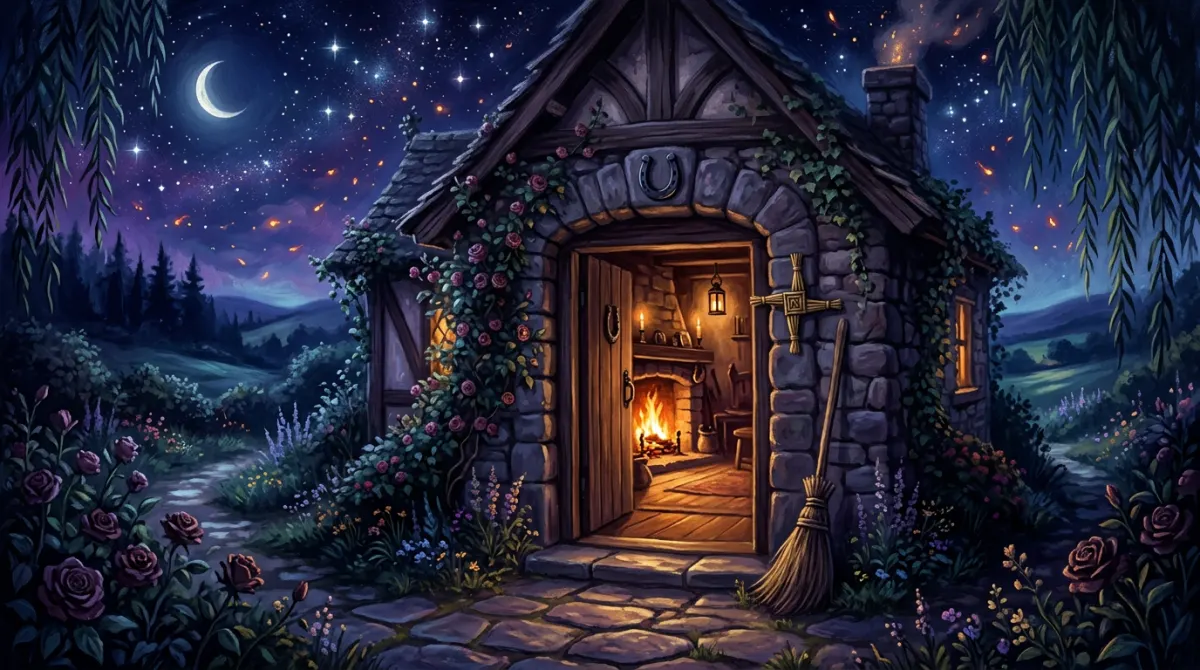
A brownie is a small, shaggy household spirit of Scottish and northern English folklore who does chores at night in return for a bowl of cream or milk and a bit of bread. Insult him, show off his work, or hand him a gift of clothes, and he leaves for good.
TraditionScottish and northern English folklore
RegionScotland, Northern England, Orkney and Shetland
Era16th to 19th century records
Moon◐ Any moon
DayAny
ElementEarth
Difficulty●○○ Simple
Time5 minutes each evening
Tonight's moon is read when the page loads.
The working
Tidy the kitchen before bed. Brownies were said to help hardworking households and to despise laziness.
Pour a small bowl of milk or cream and set a piece of bannock or oatcake beside it near the hearth, stove or back door.
Leave it quietly. In the old stories you never call out to the brownie or make a show of the gift; he should simply find it.
Do not leave clothing, shoes or cloth as a present. Every version of the lore agrees that clothes drive a brownie away.
In the morning, pour any leftover milk outside on the earth rather than drinking it or putting it back.
Keep the habit steady and modest. The point is gratitude for the unseen work that keeps a house running.
Take care: Do not leave milk out long enough to spoil, and keep it where pets cannot drink it if they are lactose intolerant. Pour leftovers away the next morning.
Versions across time and place
i
Brownie's stane in Shetland
Shetland · 17th century, recorded 1701
Brand reported that a generation or two earlier nearly every Shetland family had a brownie. When churning they sprinkled milk in each corner of the house for him, and when brewing they poured wort into a hollow in a stone called Brownie's stane.
Uses: milk, wort
Recorded in: John Brand, A Brief Description of Orkney, Zetland, Pightland-Firth and Caithness (1701)
ii
The gift of clothes
English and Scottish lore · First recorded 1584
Scot gives the first English mention of a helpful spirit vanishing after being given clothes. Later tales, like the Cauld Lad of Hilton, have the spirit singing or reciting a rhyme as it leaves, satisfied or offended.
Recorded in: Reginald Scot, The Discoverie of Witchcraft (1584), Book IV
iii
The Brownie of Bodsbeck
Dumfriesshire, Scotland · Folk tale recorded in the 19th century
The farmer at Bodsbeck near Moffat called out to his brownie after pouring the cream instead of letting him find it. Offended at being treated like a hired hand, the brownie left for the neighboring farm of Leithenhall.
Uses: cream
Recorded in: Wikipedia, Brownie (folklore)
History
Brownies belong to a family of British household spirits that includes the English hob, the Welsh bwbach and the Manx fenodyree. They were pictured as small and ragged or naked, working at night threshing, churning, sweeping and minding livestock. Reginald Scot recorded the clothing taboo in 1584, John Milton described a drudging goblin earning his cream bowl in L'Allegro, and John Brand's account of Shetland described milk and wort offerings.
Scholars note that brownies were often feared as well as welcomed; Brand called the Shetland brownie an evil spirit, reflecting the views of the Reformed church. In the nineteenth century Scottish collectors and writers such as James Hogg kept the tales alive, and illustrators turned brownies into friendly children's characters. Juliana Horatia Ewing's story The Brownies gave its name to the youngest section of the Girl Guides.